


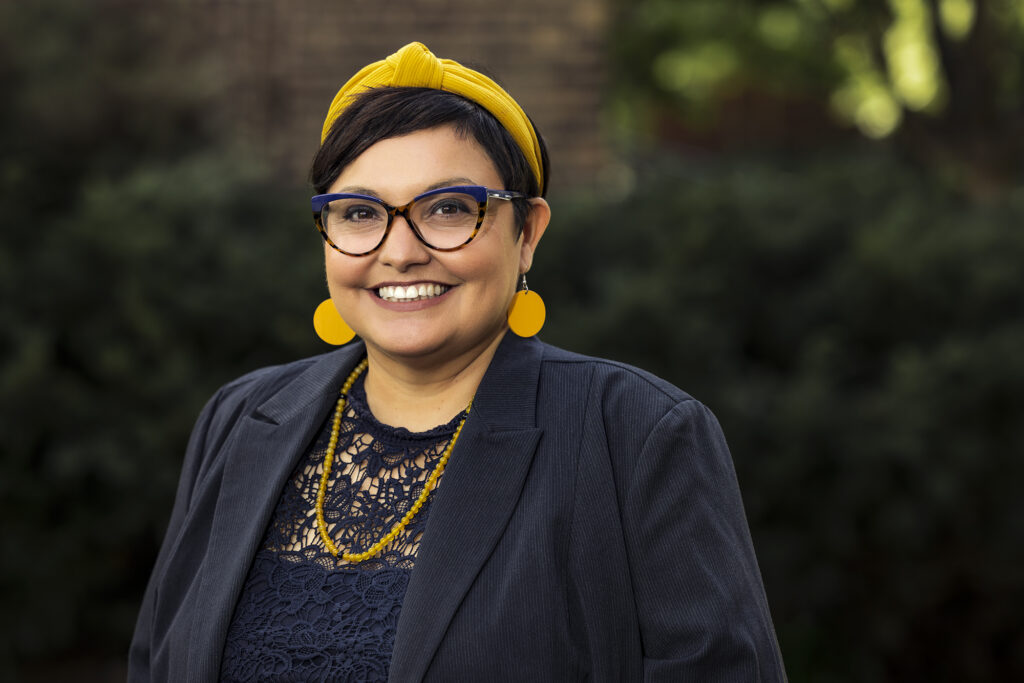
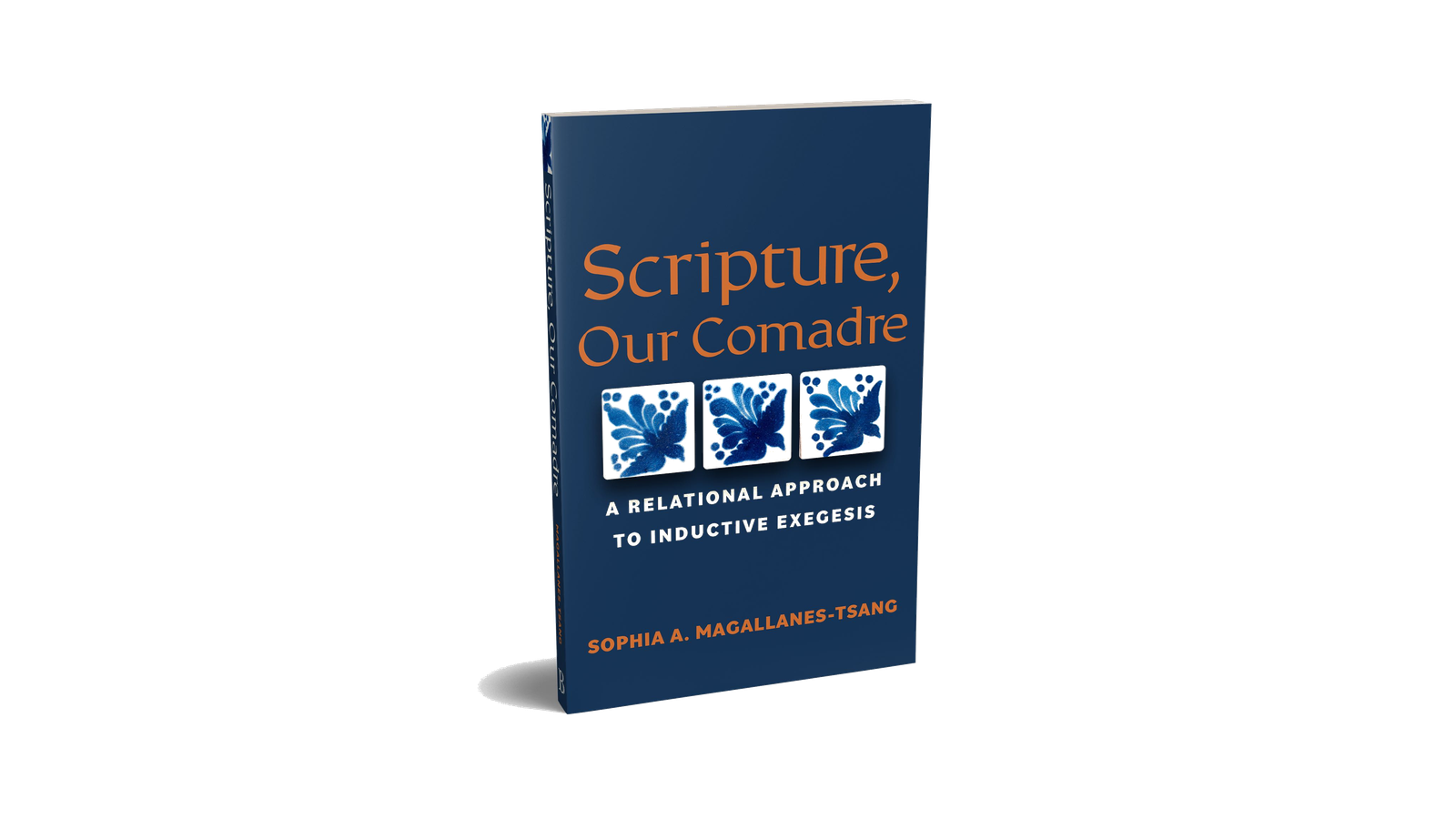
Scripture, Our Comadre came together during the summer of 2025, when I was given the opportunity to teach a summer intensive course at North Park Theological Seminary called “Reading the Word Latinamente.” Baker Academic had asked me to write a book on biblical studies from a Latina perspective, and I had been considering different approaches. Throughout my theological studies, as well as my academic education and career, I’d had to study my professors’ Northern American or European culture to understand what they were saying about the Bible and the biblical world, then recontextualize it for my own experience. But something incredible happened as I taught “Reading the Word Latinamente” that summer. I was given the freedom to dialogue with, and teach about, the Bible from my full self and experience. I began to articulate my own relational approach to biblical exegesis and to teaching it in Latino/a spaces.
Comadre literally means “co-mother.” In the Latina communities I grew up in, however, it often refers to a trusted female friend or community member, the women with whom you share life. You might have a comadre who goes to Zumba with you, helps you at the laundromat, cooks alongside you, or listens as you talk through life’s challenges. After a long day, she is the person you call simply to share your heart.
At one level, then, Scripture, Our Comadre traces my relationship with the Bible: a rich comadre relationship that has changed over time. When I first began reading Scripture at age 9, it quickly became a trusted friend I did not fully understand. I often felt it contradicted itself, though I was afraid to admit it. Yet I remained committed to it, much as I watched the women in my community remain committed to one another and value one another despite their differences and complexities.
Not long before I began middle school, a close childhood friend from church, Jacob Herrera, passed away from cancer. After his death, I carried my Bible everywhere. I was quiet, withdrawn, and sad, but my friends noticed how animated I became whenever I talked about Scripture. One day my science teacher noticed.
“Is that a Bible?” he asked.
“Yes.”
“See me after class.”
I was terrified. I expected him to be the kind of anti-Christian or anti-evangelical figure I had heard about, someone who believed science contradicted the Bible. Instead, Mr. Vega told me he was a Christian. He opened my little Precious Moments New King James Bible and showed me his favorite verse.
During the three years of high school, I was not sure I believed in God, I still read the Bible, turning to it for prayers I did not know I was allowed to pray: prayers that voiced the full range of human emotion and experience. When I rediscovered my faith in college and took my first Bible class, my professor, Bob Ramsay, then a PhD student at Claremont School of Theology, taught me how to approach the Bible as literature—a liberating experience. I felt like I was being reintroduced to my comadre, this time with a greater curiosity for her ambiguity and literary richness. As I learned more about the Bible’s background and context, I was reminded that, like my abuelita, her first language was not English. Over time, I learned to let the Bible remain silent where she is silent and speak where she speaks. In doing so, I trained myself to listen for God’s voice.
Up until this point in my career as a biblical scholar, I have not yet articulated how I have maintained faith while embracing critical approaches to the Bible. Scripture, Our Comadre is an attempt to do so: to bridge the relational way I first encountered Scripture with the academic tools that later deepened the relationship, to bridge my experience of hearing God’s voice in the testimonies of the women at church on Sunday mornings with my experience of hearing God’s voice in the academic study of Scripture.
In Scripture, Our Comadre, I show the reader how the same skills that it takes to be a good and committed friend are the same tools necessary for an inductive method of biblical exegesis. The first part of the book talks about being a good listener: un buen oyente. Then two chapters are devoted to being a metíche, or a good investigator. The reader is guided through seven steps of investigation, using tools such as structural analysis, discourse analysis, poetic analysis, word studies, historical-cultural studies, and genre analysis. The last part of the book talks about how to be a chismosa. The word chismosa (based on the word chisme) is usually used in a derogatory way—“being a gossip”—but I aim to reclaim it as discourse that leads people to course-correct and to discern a better path for their lives. In fact, I am reclaiming it based on the research of the linguist Lourdes Pietrosemoli, which suggests that chisme often can function as a tool of communal discernment and course correction within Latina populations.1Lourdes Pietrosemoli, “El chisme y su función en la conversación,” Lengua y Habla 13 (2009): 55–67. So, to become a better chismosa is to become an interlocutor, but not just any interlocutor. It is to become someone who helps the listener course-correct through the retelling of the Bible’s message to the people of God.
I believe that this book will be helpful for anyone who wants to approach the Bible academically, but in a way that integrates their faith commitments as well as their own cultural context(s). My prayer is that it awakens a greater curiosity for the Bible as Scripture for those who have trouble opening their Bible and perhaps deepen a commitment to the biblical texts that takes seriously the voices of the marginalized in our extended communities. In short, it is my hope is that in making Scripture our companion, we will learn to accompany the most vulnerable among us as well.
Join Us for the Book LaunchEndnotes
- 1Lourdes Pietrosemoli, “El chisme y su función en la conversación,” Lengua y Habla 13 (2009): 55–67. ↩︎
SHARE WITH FRIENDS