


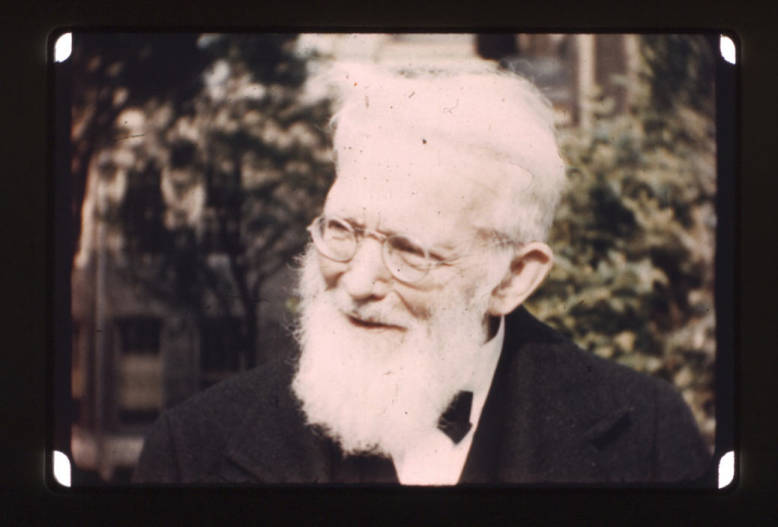
David Nyvall (1863–1946), founding president of North Park University and Theological Seminary, was an impactful leader. He was purposeful in requiring his church to think innovatively about its philosophy of education. He is relevant today because he established an academic culture that has sustained and extended an immigrant community beyond its first generation. “Full of ambition,” he addressed the student body on North Park’s tenth anniversary (1901) and shared his vision for the young institution:
“I would fain make this school a college, yea, a university. … I would make this dear community of ours a center of thought and art to the whole civilized world… making this school a center from which radiates to all ends of the world the light of Christ’s truth, and the warmth of Christ’s love, and the beauty of Christ’s character. [This would be] a school with a schedule [for] becoming a Christian university.” 1David Nyvall, “The Poetry of Missions,” reprinted in Linnea, 1901, p. 333. See also Karl A. Olsson, Into One Body…by the Cross, vol. 1 (Chicago: Covenant Publications, 1985), 202.
I begin with Nyvall’s vision for the Christian university because it so clearly demonstrates his leadership, foresight, and call to action at the end of North Park’s first decade. By that time Nyvall had already articulated a conceptual framework for the Covenant Church’s school: theological training for pastors and a liberal arts curriculum for immigrants who otherwise would not have access to the American academy. Although his desire for a Christian university was not in near-term reach in 1901, it is clear that Nyvall wanted to inspire other leaders to carry his vision forward—a vision that is now a reality and that was made possible by his intentional leadership as North Park president for a quarter-century. As we celebrate North Park University and Theological Seminary at 125, it is important to reflect on Nyvall’s philosophy for Christian higher education, the leadership that was required to establish the school, and what he did to ensure its success 125 years beyond its founding.
Nyvall’s Early Faith and Intellectual Temperament
David Nyvall’s leadership is rooted in his precocious character and complex personal history. It begins in youthful self-discovery in Vall, his rural family homestead near Karlskoga in the south-central county of Värmland, Sweden. David later reflected on mid-nineteenth-century life with a brooding, troubled mother and an absent father whose religious fervor took him on frequent preaching trips. He wrote: “Things were as they were because of circumstances and responsibilities. And there was a certain temperament, which for lack of a better term, I choose to call a Karlskoga temperament—half cautious, half modest and shy—when it comes to expressing more tender feelings.” 2David Nyvall, Min Faders Testamente (Chicago: Scandia Print Co., 1924), 373. David’s father, C.J. Nyvall, was a traveling preacher, riding his horse Hulda with Bible in hand, always ready to preach a sermon. Formidable, he was an organizing force behind the Mission Friends movement. He was present at inaugural meetings for the Covenant Church in both Sweden and America.
While his siblings and others around Vall worked in field and meadow, David read books, lying in a ditch or by a tree. When others reported the bookworm’s lack of cooperation with practical chores, C.J. Nyvall took David’s side. David later reflected in an interview that his young mind was buzzing with new ideas and goals. 3Interview by Olga Lindborg in Friska Vindar, April 1, 1933, pp. 97–99. Covenant Archives and Historical Library (CAHL).
When his parents left for a visit to the United States, David began studies that ultimately prepared him for matriculation at Uppsala University. This opportunity was atypical for a farm boy who liked to read books in a ditch. But his father had contacts and opened doors, and David harbored ambitions and what he called intellectual pursuits: “I wrote volumes before I was fifteen—for the wastebasket… It seems that my pen is my permanent instructor.” 4David Nyvall to Theodore W. Anderson, fall 1942, David Nyvall Charn Collection 1:10, CAHL.
David toyed with being a poet. His father worried about his son’s ego and lack of spiritual purity, praying that God would redirect his son’s worldly ambitions. 5C.J. Nyvall diary entry, December 28, 1878, Riksarkivet, Stockholm. For the traveling preacher, Christian faith was of preeminent importance, and conversion was “the one thing necessary.” This renewal movement—led by Mission Friends and later the Covenant Church—was defined by conversion and the question “Where is it written?” These were the branding promises of the movement.
The young David Nyvall wrestled with this new approach to faith. He did not despise worldly things. He found his faith complex and enigma-filled, writing: “It was like a fever that boiled and burned within me… Despite all the doubts, questions, and adventurous thoughts, I still had a deeply religious nature… I was split and divided from within.” 6Interview of David Nyvall by Olga Lindborg, CAHL.
His father sent the brooding teenager to study with P.P. Waldenström, who taught him to read Scripture in its original languages and to live by “Where is it written?” Hoping for his son’s conversion, the elder Nyvall sent David into this mentorship. Yet David remained melancholic, describing himself as living “in the minor key.” His diary entries from the early 1880s reveal torment over spiritual and intellectual struggles. 7David Nyvall diary entries, March 31–August 6, 1882, CAHL.
At Uppsala University (1883–1886), David encountered Darwin, Rydberg, and Kierkegaard’s Sickness unto Death. Kierkegaard profoundly shaped his theology and self-understanding, leading him to embrace paradox, irony, and the existential nature of faith. He chose to study medicine—his father’s compromise for a son not suited to itinerant preaching. But in this choice one sees the beginnings of a mind that insisted on synthesis between faith and intellect.
Nyvall never had the simple, ecstatic conversion his father preached. His faith remained intellectually turbulent, rooted in questions, tension, and the written word. Karl A. Olsson would later recall asking him, “Have you ever doubted God?” to which Nyvall replied, “I have never doubted God. But I have doubted Christ.” 8Scott Erickson interview with Karl A. Olsson, November 3, 1994.
Establishing an Academic Culture
Arriving in the United States in 1886, Nyvall soon began teaching immigrants in Minneapolis. His first classroom—“Skogsbergh’s School”—was a cold church basement where he lectured in a fur coat to keep from freezing. 9C.V. Bowman, Son of the People (Chicago, n.d.), 164–66. His passion for awakening intellects among working-class immigrants became his calling. Within a decade, he would become president of a new school—the Covenant Church’s North Park College (founded 1891).
Nyvall saw education as the means for sustaining the immigrant community. In 1896 he wrote that Americanization was not forgetting Swedish identity but using the best of oneself in a new land: “Learn English—and do not forget Swedish! English will save Swedish.” 10David Nyvall, “Att amerikaniseras,” March 1896, CAHL.
To critics who thought education should be limited to a “simple Bible school,” Nyvall replied that the Covenant school must include business, theology, and liberal arts—forming pastors who understood culture. 11Letters to C.A. Björk and Gustaf Almfeldt, August 14, 1893, Covenant Ministers Collection, CAHL. He rejected narrow utilitarian education, insisting that Christian formation demanded intellectual breadth.
His philosophy provoked opposition. Some argued education should focus solely on training pastors. One immigrant wrote warning against “eating from the tree of knowledge,” calling higher learning a temptation. 12E. Danielsson to David Nyvall, 1892, CAHL. But Nyvall’s vision prevailed. North Park would offer “clear and unadulterated waters from the springs of knowledge to the thirsting ones,” cultivating pastors “educated in the liberal arts.” 13David Nyvall, “From North Park,” Covenant Quarterly 13, no. 2 (1953): 36–38.
Further Defining an Academic Culture
Nyvall’s philosophy matured through correspondence with Charles Blanchard, president of Wheaton College, between 1914 and 1918. Blanchard decried secular universities as “devil’s doctrines” and urged Christian separation. 14Charles Blanchard to David Nyvall, October 26, 1914, Covenant Ministers Collection, CAHL. Nyvall countered with a generous vision of Christian higher education, rejecting anti-intellectualism. He asked: “Is every good thing divine? Is everything bad the devil himself? If a university is not Christian, may it not be a university?” 15David Nyvall to Charles Blanchard, October 30, 1914, CAHL.
He defended engagement with science and modern learning, arguing that Christian character, not isolation, safeguarded faith. “How can ambitious students be persuaded to choose their colleges because of religious atmosphere? They would have to see that [as a] choice between efficiency and character.” 16David Nyvall to Charles Blanchard, May 22, 1918, CAHL. For Nyvall, faith and intellect were not adversaries but collaborators in the Christian university.
Conclusion
North Park University, now 125 years since its humble founding, has been successful and is thriving today because of Nyvall’s inspirational leadership and the enduring strength of his vision. Education in the Covenant Church was not relegated to a simple preacher’s school because David Nyvall inspired his church to embrace an expansive view of the Christian academy. He established an academic culture to nurture the intellect and sustain Christian faith in an increasingly complex world. He required his first-generation immigrant peers to stretch their thinking about education in their adopted country. Nyvall led intentionally through words connected to actions, and he did so amid significant resistance. His philosophy of education, developed over four decades, would deepen and grow to benefit his immigrant community and its successive generations.
The practical outcome of his leadership, the institution he led, was neither a fundamentalist school nor an unsustainable, one-generation school for immigrants. Rather, the result is evident in the fruit of his lifework: North Park flourishes today as a university with deep institutional roots, a commitment to higher education, and a clear Christian identity. North Park still embodies the vision articulated by Nyvall in 1901: to be “a center from which radiates to all ends of the world the light of Christ’s truth, and the warmth of Christ’s love, and the beauty of Christ’s character.” Many generations of North Park graduates are the beneficiaries of David Nyvall’s lifework and vision for the Christian university.
This article originally published with The Covenant Quarterly in November 2016.
Endnotes
- 1David Nyvall, “The Poetry of Missions,” reprinted in Linnea, 1901, p. 333. See also Karl A. Olsson, Into One Body…by the Cross, vol. 1 (Chicago: Covenant Publications, 1985), 202. ↩︎
- 2David Nyvall, Min Faders Testamente (Chicago: Scandia Print Co., 1924), 373. ↩︎
- 3Interview by Olga Lindborg in Friska Vindar, April 1, 1933, pp. 97–99. Covenant Archives and Historical Library (CAHL). ↩︎
- 4David Nyvall to Theodore W. Anderson, fall 1942, David Nyvall Charn Collection 1:10, CAHL. ↩︎
- 5C.J. Nyvall diary entry, December 28, 1878, Riksarkivet, Stockholm. ↩︎
- 6Interview of David Nyvall by Olga Lindborg, CAHL. ↩︎
- 7David Nyvall diary entries, March 31–August 6, 1882, CAHL. ↩︎
- 8Scott Erickson interview with Karl A. Olsson, November 3, 1994. ↩︎
- 9C.V. Bowman, Son of the People (Chicago, n.d.), 164–66. ↩︎
- 10David Nyvall, “Att amerikaniseras,” March 1896, CAHL. ↩︎
- 11Letters to C.A. Björk and Gustaf Almfeldt, August 14, 1893, Covenant Ministers Collection, CAHL. ↩︎
- 12E. Danielsson to David Nyvall, 1892, CAHL. ↩︎
- 13David Nyvall, “From North Park,” Covenant Quarterly 13, no. 2 (1953): 36–38. ↩︎
- 14Charles Blanchard to David Nyvall, October 26, 1914, Covenant Ministers Collection, CAHL. ↩︎
- 15David Nyvall to Charles Blanchard, October 30, 1914, CAHL. ↩︎
- 16David Nyvall to Charles Blanchard, May 22, 1918, CAHL. ↩︎
SHARE WITH FRIENDS