


A Decade Later: North Park Theological Seminary Female M.Div. Graduates (1977-1987)
November 18, 1988
Mary C. Miller
Background for the Ordination of Women
One Covenant pastor remembers the 1976 vote to ordain women in ministry by observing, “The vote to ordain women was not born of conviction but of exhaustion.”1Clifford Johnson, president of the Covenant Ministerium.
His tongue-in-cheek description is reflected in the minutes of that Annual Meeting. Four- and one-half pages describe the struggle of the delegates over the Board of Ministry’s “Divorce and Remarriage: A Policy Statement.” The paper, an update on a 1961 statement, was distributed and read, then extensively debated and amended. Debate continued until there was a motion to let the issue stand recessed until the next day, Friday. The next morning the discussion continued, finally concluding with a closed, paper ballot. A few minutes later the Board of Ministry presented another paper, a “Statement on the Ordination of Women,” which had been distributed the previous day. It was not read aloud in the meeting, debate was limited to two minutes per speaker and voting time was predetermined for 11:45 a.m. At that time the statement was approved by voice vote. In contrast to the “Divorce and Remarriage” paper, the one of “Ordination of Women” fills thirty lines of one page in the meeting’s minutes.2Covenant Yearbook 1976 (ECCA, 1976) 171-177. In fact, the paper itself is not even recorded there.3“Statement on the Ordination of Women”(Board of Ministry, 1976) Can women serve in the ordained ministry of the Covenant Church? Can the Church rightfully administer the rite of ordination to women who have been called to ministry of the Gospel and who meet the qualifications for ordination as set forth in the Rules of the Board of Ministry?
This statement is presented for study and discussion, with the hope that the Church might arrive at a decision on this crucial matter.
I. WHAT IS ORDINATION IN THE COVENANT?
Ordination has been defined as “the formal bestowal of ministerial office, supplementing the inward call of the Spirit with the authority of the church publicly given by its agents competent to ordain.” Historically, there have not been many official pronouncements on the meaning of ordination in the Covenant Church. The records that we have deal largely with rules and regulations for ordination.
In 1973 the Covenant approved, at its Annual Meeting, a complete revision of the “Rules of the Board of Ministry.” One significant change in those rules was the attempt to remove any reference to gender, thus making it possible for the church to consider the ordination of women into the ministry of the Covenant Church.
The rules, in Article II, Section 1, define ordination in this way: “Ordination in the Covenant is an act of the church by which a servant of God is formally set apart for ministry. The church ordains only after determining through careful examination that the candidate has been called of God, is genuinely committed to the apostolic message, and lives in conformity to it. In ordination the church gratefully accepts the ordinand as one called by God and given to the church to minister in the Spirit of Christ.” Nowhere in that definition of ordination, nor in the “Qualifications for Ordination,” is there any indication that women, who have been “called of God” and are “genuinely committed to the apostolic message and live in conformity to it,” can be denied the rite of ordination if that is their desire.
By its very rules, the Covenant Church can rightfully administer the rite of ordination to women.
II. WHERE IS IT WRITTEN?
Historically, it is true that whenever our fathers were confronted with an issue of theology or church polity one of the first questions to be asked was the question, “Where is it written?” From its beginnings the Covenant Church has regarded “the Holy Scriptures, the Old and the New Testament, as the Word of God and the only perfect rule for faith, doctrine, and conduct.” Therefore, it is imperative that we raise that question again in dealing with the issue at hand.
Certain passages have been cited through the years for the subordination of women and against their ordination. These passages are of such importance that we must examine them in some detail.
1 Corinthians 11:3-16. It appears that the issue at hand in this passage is not so much the prohibition of women from places of leadership in the church as it is the matter of their covering their heads. The context of the passage indicates that Paul is here defending the decorum of the day in the light of the culture of that society. Women were to be veiled in public places. That, however, did not exclude women from praying and prophesying in the church. That they were already doing in Corinth (v.5), and Paul gives no indication here that they should cease and desist, only that their heads be covered.
In the same passage (vv. 11-12) Paul goes a step further, indicating that in Christ men and women were interdependent (i.e., “Nevertheless, in the Lord woman is not independent of man, nor man of woman; for as woman was made from man, so man is now born of woman.”) Therefore, women may continue to pray and prophesy.
1 Corinthians 14:33-36. This passage, if taken seriously, immediately raises a contradiction that must be resolved. How can it be that Paul allowed the Corinthian women both to pray and prophesy in chapter eleven, while in this passage he forbids them to speak in the church? Was it that Paul was giving permission to prophesy in chapter eleven, but stating his own preference against it in chapter fourteen? Or was it that his term for women here in this text likely meant “wives” rather than “all women”? Or perhaps Paul was simply irked with wives who had interrupted the worship services.
Whatever the explanation for the apparent contradiction, the problem here makes this passage questionable grounds for the prohibition of ordination for women.
1 Timothy 2:8-15. There are few passages in the Scriptures which have aroused more heated discussion than this one. Taken literally as authoritative commands these verses would exclude women completely from all leadership in the church. It is obvious that such an interpretation was not actually practiced in New Testament churches. Paul’s letters contain the names of many women who were prominent in the work of the New Testament Church: Lydia, Dorcas, Priscilla, Euodia, Syntyche, Phoebe, Mary, Rhoda, the mother of Rufus, the sister of Nereus, and others.
Again, it appears that Paul is here reflecting the custom and culture of his day, in the light of which Christian women would have been subject to criticism had they been conspicuous in public. Therefore, these texts do not justify anyone claiming that Paul explicitly and deliberately extends the binding force of his rules to all churches till the end of time. Paul refers us to the authoritative account of God’s creation of marriage as the basis for his rule concerning the behavior of women in the churches, but he also requires us to think for ourselves and to consult our own Spirit-guided biblically-corrected social sense of what is upright and virtuous and then to mold and maintain customs and practices in the Church which will preserve its holiness.
But Paul raises another issue in this passage when he bases his argument here for the subordination of women on the “orders of creation.” This points us to another argument against the ordination of women, and argument that states that women’s subordination to man is written into the very structure of the universe. As Paul writes here, “For Adam was formed first, then Eve.”
The pertinent question here is whether the “order of creation” is understood in a static sense, as for all time God had determined a set pattern. Or whether God’s ordering activity is a dynamic reality. Did God ordain an eternal, unchanging subordination of woman to man, or, instead, is he actually changing the “orders of creation” by his constant activity in history?
Then too a closer look seems to reveal that the subordination of women was not an order of creation after all, but an order of judgment. It was only after the Fall that God said to Eve, “Your husband shall rule over you” (Genesis 3:16).
But the decisive question is this: Were the orders of creation all upstages by the order of redemption? Did the coming of Jesus Christ change the relationship between man and woman? Man and woman were created free and equal within a harmonious world (Genesis 1:27-31). However, after the Fall man was subject to struggling with nature, and woman to the pain of childbirth and man’s rule.
But in the New Covenant not only is the original order restored but it is also transformed by being “in Christ.” Women are no longer subordinate to men, but men and women are “subject to one another” in the Lord (Ephesians 5:21). They are interdependent in Christ (1 Corinthians 11:11-12), joint heirs in Christ (1 Peter 3:7), and equal in Christ (Galatians 3:28).
In Galatians 3:28, Paul affirms that”there is neither Jew nor Greek, there is neither slave nor free, there is neither male nor female; for you are all one in Jesus Christ.” The weight of Paul’s words affirms that to be in Christ is to be in a present kingdom where there is no distinction between persons. Greeks and Jews are accepted on equal footing. Slaves and free men become brothers, men and women minister side by side in spreading the gospel. There are no second-class citizens in Christ’s Church.
It is also significant that whenever Paul speaks of the gifts of the Holy Spirit he does so without any reference at all to gender. The gifts of the Spirit are distributed among the whole body and are to be used to build up the body of Christ. There is, again, no indication that women in the body are excluded from the gifts of apostleship, of the prophet, evangelist, pastor, and teacher. Those gifts are available to women in the same manner as they are available to men!
It is well to consider, also, the record of the New Testament. A woman was the first to see the resurrected Lord, women were the first to be told of the Lord’s resurrection, and they were the first to be commanded to tell others of the Lord’s resurrection (John 20:16; Mark 16:17; Matthew 29:7; Luke 24:22-23). Women played a major role in the history of salvation. Women proclaimed the gospel as prophetesses (Luke 2:38; Acts 2:17; 1 Corinthians 11:5), they served as deaconesses (Romans 16:1; 1 Timothy 3:11), and Priscilla and Aquila, Paul’s “fellow workers in Jesus Christ” (Romans 16:3) “expounded the way of God more accurately” to Apollos (Acts 18:26).
And finally, there is the place given to women in the life and ministry of Jesus. There is little doubt that during his entire life Jesus dumbfounded his critics by the place he gave to women in his ministry. There was Mary Magdalene, and the other women who came the empty tomb on resurrection day. There was the woman of Samaria beside the well. Jesus broke all tradition not only by speaking to a Samaritan, but by speaking to a woman in public. From the evidence in the Gospel account Jesus elevated the status of women in his day and was glad to number them among his closest group of followers.
Though one can find good evidence to support both the subordination of women as well as clear evidence to support their right to ordination, the overriding principles of New Testament Faith clearly make it possible for the Church to consider the ordination of women into the ministry of the Covenant Church!
III. WHAT HAVE WE DONE?
Covenant Tradition and practice regarding the role of women in the ministry of our churches is living evidence that we have not followed a more restrictive interpretation of those scriptures often used to preclude the ordination of women. In our churches women are already ministering in ways that include almost every function of ordained ministry. Women teach, counsel, organize, administer, direct our choirs, and play our musical instruments. They also evangelize, lead in Bible studies, write books, and encourage, inspire, and build up the body of faith. Women serve in every elective office in our churches, from chairperson to board of trustees. They are vital to every stewardship effort and are active participants in the church’s ministry of visitation. For decades our women missionaries have performed many of the functions of our ordained clergy. They have preached, taught, administered, and shared in the life of the church.
We already have women who hold ministerial license, which grants them the right to preach the Word and administer the sacraments. To give them ordination is to recognize fully ther ministry.
Because women have played such an important and vital role in the ministry of the Covenant Church throughout its history, it seems appropriate that we now allow those who desire it the rite of ordination as the culminating act in the individual and public stewardship of God’s grace in their lives! This is the very intent of our Lord who ministered to and received all on equal ground. Since Jesus treated men and women as “full persons” equally so should the Church by ordaining both!
Our historical practice calls forcefully for granting women the rite of ordination.
IN CONCLUSION
It must be said that for the Covenant to ordain women will be one thing, but how the Covenant Church will utilize these ordained persons will be another. The study of the experience of other denominations tell us that its acceptance is a slow process. There are 80 of 262 denominations in the United States who ordain women, and some of them have done so for years. However, not more than 5 percent of the ministers in those churches are women, even though over half their members are!
The acceptance of ordained women clergy in our Covenant churches will require specific educational efforts to achieve more general understanding and concern. Attitudes are best changed by experience, and when women have an opportunity to become pastors, then ordained women will find increasing acceptance.
The practical problems are real but not overwhelming. A woman who desires to be a pastor must seriously consider what effect her vocation will have on her marriage. A woman pastor may have responsibilities to her home, husband, and children, and this may make her style of ministry different from that of a man. Even as a man may not be completely effective because he is a man, so a woman may be limited by her womanhood. We could say that there are as many practical problems for the man in ministry as there are for the woman.
Because the basic concern of the ministry is the proclamation of the gospel, and in the light of the biblical, historical, and theological study, which is presented in this paper, the Board of the Ministry is convinced that the time has come for the Covenant Church to give serious consideration to the ordination of women.
Therefore, the Board of Ministry recommends to the Ninety-first Covenant Annual Meeting that the church go on record as favoring the ordination of women.
These dozen years since that “exhausted” but historic vote have been formative ones for the acceptance and rejection of women in Covenant ordained ministry. In 1981 a motion to rescind the vote to ordain women was defeated.4Evangelical Covenant Church of America, Covenant Yearbook 1981 (ECCA, 1981), 240. The following year, a more extensive rationale for women’s ordination than that of 1976 was presented to the annual ministerium and denominational meeting.5Klyne Snodgrass, Ph. D., “A Biblical and Theological Basis for Women in Ministry,” Chicago, 1982. Available through the Department of Publications. Twenty-three women have been ordained since the original vote.6Ordained Covenant women1978Hughes-Tremper, Sherron
Shimmin, Carol J. (Nordstrom)
1979Cole, Adele
1980 Lang, Carla
1981Sandin, Marilyn
Miller-Vikander, Mary
Lundblad, Janet
1982Anderson, Isolde
Lambert, Jean
1983Palmatier, Karen
Potts, Jan
Bouts, Cathy
Wiebe, Marie
Dickson, Pat
1985Anderson, Frances
Casey, Helen
Floto, Lynne
1986Decker, Frances D.
1987Benson, Joanne
Roth, Carol
Werner, Ruthanne Lovain
1988Krekelberg, Anne
Morrison, Laurel B.
Protocol and Data of Questionnaire
What progress have we made as a denomination in training and placing women in Covenant Ministry since the 1976 vote? In April a questionnaire was mailed to the primary sources on the subject.7Covenant Quarterly Survey:
What year did you graduate from North Park Theological Seminary? With what degree?
What was your church membership upon entrance to North Park?
What is your present church membership?
Are you ordained?
As of May 15, 1988, are you presently serving a Covenant church? If yes, in what job title? Part-time or full?
Is this a church in which you were a layperson before gaining your theological degree?
Are you presently serving a church of another denomination? If yes, name of denomination, job title, part-time or full.
If not serving a church in a pastoral role, please indicate what work you are doing at the present time.
When you graduated from North Park, did you place your name in process for a pastoral call in the denomination? If no, indicate the reasons: decision to enter specialized ministry, change in job interests, anticipated difficulty in the Covenant’s placement process, theological differences with denomination, other.
Please list the contacts you had from Covenant churches in the first year after graduation during the placement process. Phone calls from conference superintendent, phone calls from church members, phone calls from search committee, meeting with church search committee, meeting with congregation, senior pastor of church needing multiple staff, phone call from pastor near the open church who called to inform you of opening.
If you were a member of the Covenant denomination upon entering North Park but are not a member now, please check the reason(s) for your change: theological differences, inability to find placement in a church, change in career goals, more support for women in ministry, comments.
If appropriate, tell how placement as a woman has been easy for you.
If appropriate, tell how placement as a woman has been difficult for you.
Mark an “X” where you perceive the Covenant denomination’s relationship to women in ministry to be.
Positive ___________________________________________________________________ Negative
Explain.
If you had a magic wand, what would you do with it to aid the progress of women in ministry in the Covenant?
Comments of encouragement and/or discouragement. Date, name, (optional).
The sample selected were North Park Theological Seminary women who earned Master of Divinity degrees since the vote who could have entered the placement process (1977 to 1987).8North Park Theological Seminary, Women M. Div. graduates (1977-1987)
1977
Sharon Hughes-Tremper
1979
Sharon Engebretson
1980
Janet R. Lundblad
Mary Miller-Vikander (Mary C. Miller)
Rumona Mord (Rumona Mord-Jacobus)
Marilyn Sandin (Marilyn Sandin Alexander)
1981
Janice Erickson-Pearson
Isolde K. Anderson
Marlys Rudeen
1982
Catherine Bouts
Karen Pearson (Karen Palmatier)
Jan Hallstrom-Potts (Jan Potts)
1983
Janet Pierson-Kyle
1984
Helen H. Cepero
Eileen Lundquist**
Dawn Swartz
Ruthanne Werner
1986
Aina Pulin
Stacey Wagner-Noble
1987
Catherine Campobello
Michelle J. Guest
Debra Gustafson
Ann Marie Krekelberg
Cheryl Larsen
Deborah Power*
Melanie Tornquist
*questionnaire not returned
**no forwarding address available North Park was selected because of its focus on Covenant students and commitment to the denominational placement process during those years. By limiting the sample to the denominational school, the issue of placement could be more clearly examined. This meant excluding others. Women graduating before or after those dates were not included.9Omitted was Carla Lang, a 1976 graduate presently serving as A. A. C. P. certified counselor in Winston-Salem, North Carolina, in process of transferring her ordination to the Evangelical Lutheran Church of America. Nearly half of the ordained Covenant women have graduated from schools other than North Park and are voiceless in this study.10Women Master of Divinity graduates in the Covenant have attended Bethel, Fuller, Northwestern Lutheran, Union, and Yale Theological Seminaries. Women who graduated with degrees other than Master of Divinity are excluded. The research did not purpose to make comparison or contrast to women Master of Divinity graduates in other denominational seminaries or even to the men graduates of North Park although such studies would be enlightening. Neither did it solicit the insight of those Covenant women who transferred out of North Park to other seminaries. All answers are dated May 15, 1988. The study is not to make predictions but to give a snapshot, a full panorama, at this given moment twelve years after the vote. It is meant to illumine our present situation with this collection of personal histories and observances as the central resource.
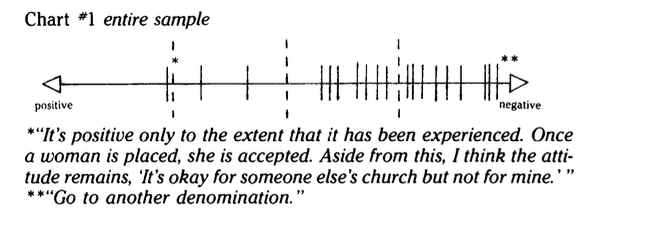
The questionnaire elicited twenty-four returns with one unreturned. (The task of obtaining contemporary addresses proved the first hurdle.) Only two of the respondents entered seminary with membership in other denominations (United Methodist and Latvian Lutheran) and graduated to serve in them. Seven respondents who entered seminary as Covenant members have changed or are changing their denominational affiliation. Thirteen are ordained, eight of them in the Covenant. Twelve women are pastors, seven of those in this denomination. Three of the four hospital chaplains are Covenant; both military chaplains are. There is one short-term missionary and one “home turf” missionary (a homemaker with young children). Fourteen put their names in for Covenant placement while nine did not. One had a call prior to the placement process. They were all asked to “mark an X where you perceive the Covenant denomination’s relationship to women in ministry to be.”
Comparison by Half Decades
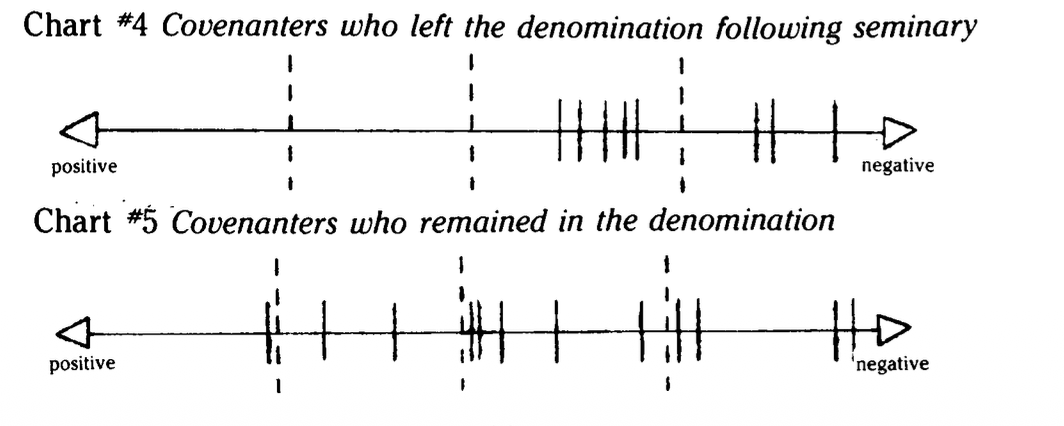
A comparison between the chronological first half of the time span (1977-1982) and the second half (1983-1987) seemed natural when both groups totaled twelve. Both groups also had two hospital chaplains and a military chaplain. Beyond that, there were sharp contrasts. The most visible indication of the differences in the two groups came in plotting the responses to the former exercises by seniority group. The respondents of the first half the decade indicated a significantly wider view of the denomination’s acceptance of ordained women than those of the latter half of the decade. The earlier twelve found five respondents in the most pessimistic quadrant, four cautiously so, two cautiously optimistic, and one clearly so (given her qualifying statements quoted from Chart #1). The chart of the latter half of the decade brought a sharp contrast to the first half with none of the women optimistic at any point about the denomination’s relationship to women ministers. All marks were on the pessimistic half of the spectrum; seven of the cautiously pessimistic and five of them in the most negative quadrant.
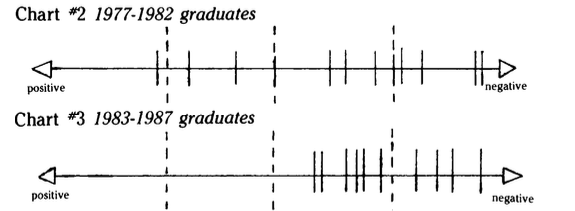
The picture is supported by data. In the first group, six women are presently in Covenant pastorates. Two others began seminary as Covenant members but transferred to other denominations (Evangelical Lutheran and United Presbyterian), both citing a threefold reason for leaving: theological differences, inability to find placement in a church, and more support for women in ministry in another church. Only one of the twelve did not put her name into the placement process; she remains in secular work and holds Covenant church membership at this time.
The numbers change significantly for the second half of the long decade. Instead of six being placed as Covenant pastors, there is one. There are double the number who left the Covenant to minister in other denominations (United Church of Christ, Evangelical Lutheran Church of America, and an independent church). Instead of one withdrawing from the placement process there are six, three of them presently in membership in the Covenant. All the women who left or are leaving the church cited both the inability to find placement in a church and more support for women in ministry elsewhere as reasons for their departure. They are less likely than their earlier colleagues to see theological differences with the denomination as a reason (it was marked by two of the seven leaving the denomination).11
Those Who Left
Several trends and components emerge as the responses of those graduates who left the Covenant are analyzed. Inability to find placement and lack of support for women in ministry is stated by all six pastors who left the Covenant to be placed in other denominations. Their leavetaking makes Glenn Anderson, former dean of North Park Theological Seminary and church historian, an accurate prophet: “Ordaining women pastors will never be a problem for the Covenant. It is placing them in churches that will be!”12Mary Miller-Vikander, “A Beginning Together” in Women as Pastors, ed. Lyle E Schaller, Creative Leadership Series (Nashville: Abingdon Press, 1981), 76. That their number has doubled in these last five years measures the amount of ground being lost in the placement issue. That the number of Covenant women who have left the denomination for other churches has tripled in those years is also distressing. That they did so after the intimate long-term investment of a four-year seminary relationship measures their sacrifice in leaving. One woman presented her rationale for leaving.
The Covenant does not want to appear completely backward culturally so the issue is talked up at denominational meetings. However, when it comes to taking action to support women in ministry, the determination is just not there to follow through.
I really don’t think the Covenant is willing to take the risk of throwing everything it can behind women in ministry. The bulk of its membership does not consider it an issue worth acting on. In fact, there is a substantial split in regard to the issue of the ordination of women in the first place. As a result, nothing substantial is ever done toward addressing the issue.
Bottom line, I believe the issue of women in ministry is a theological issue related to the Covenant’s understanding of the doctrines of the image of God, of mission, of humanity/sexuality, of revelation, to mention a few. The bulk of the Covenant’s membership is theologically conservative and supports the traditional notion of the image of God as male and of minister as male.
The resistance to women in ministry is rooted in theology. This theology must change in order for women to be accepted as ministers. The stance of the Covenant toward this kind of change is basically closed. The Covenant does not want to risk offending its membership by standing with women in ministry in anything but a token few. The Covenant really does not want to be bothered.
One pastor in another denomination wrote of the separation and severance from her childhood Covenant roots. “I feel my denominational move was like a divorce, but I trust God’s provision.” Wounds of sacrifice were related. “I graduated in 1985 and by 1986 when all the men in my class had been placed, I got one interview at a church which was isolated and obviously a bad place for a single woman from the inner city. I got no more interviews though I waited still another year.” In other words, “It was less traumatic than to stay.” Severance pains in leaving itself are repeated by many voices.
When my strength and passion for ministry and the church returns, it will be interesting to see where my heart is concerning the Covenant. Right now my anger and hurt at our frequent blindness and impotence to heal the broken-hearted and bind up their wounds is too strong to predict any involvement in the Covenant in the future.
A woman presently leaving the denomination tells her story with clear analysis:
As a woman in ministry with the Covenant, I was regarded by the denominational executives as either invisible or as a thorn in the flesh. The token speeches or gestures made toward supporting women in ministry were too few and too thin. [That] the Covenant places the issue of women in ministry at the bottom of their agenda communicates this lack of support not so much by what is said by what is not done. Women face the terrors of placement largely alone, and that is a devastating prospect.
I am sad to have to go elsewhere to find that support, but I won’t be a martyr for the Covenant. I have too much to offer. The vision of the Covenant does not include me.
One respondent wrote in rambling eloquence of a sorority of exiles.
My close friends are the women with whom I share the horrible experience of completing NPTS and then waiting and wondering if we’d get jobs; them gambling our very lives and futures on it; then slowly realizing that God doesn’t make justice happen; God asks people to do it. When I could stand the pain no longer – that of being ostracized from the very community I loved and wanted to be within, I moved on easily to find a call elsewhere, without a hint of prejudice; so I have left the Covenant along with too many others.
The joy of newly found support came from one in another church: “I feel grateful and lucky to have such freedom and strong affirmation and a strong sisterhood in my new denomination. I covet that for you.” Looking back over her loss, another writes of the sovereignty of God in her life. “When it appears that one door closes, God opens another. Always look for the crack in the door. In spite of the difficulties I have had with the Covenant and the hurt they have caused me, God has truly blessed and enriched my life through my current ministry.”
Several pastors in the chronological first half of the survey indicated their perceptions of this exodus movement. One with seniority wrote the following: “I sense a maturing in the group that was ordained in the first five to six years. But I am concerned that we have become too comfortable. I am not invested in any of the women seminarians and know few of the recent graduates.” Some responses indicated more awareness of the newer women, especially one who said, “I worry about the women who are just entering pastoral ministry.” One gave a concerned analysis:
A year and a half ago, a denominational leader told me that there were half a dozen women graduating from seminary who were “strong, well-rounded, gifted people. This year should be the telling point for us. If we can”t place this group, we’re in trouble.” I guess we’e in trouble. Not one 1987 woman graduate has a place in a Covenant pastorate at this time. The one woman who graduated in 1988 has yet to be placed.
Another wrote, “When I began ministry eight years ago, I did so with full hope that there would be others, women as ‘settlers’ who would follow, surpass, better us ‘pioneers.’ Now I find that hope not just frustrated but pretty much shattered.” And one “oldtimer” who ministers in another denomination said, “I have seen the effect the lack of support for women clergy in the placement process and the lack of pro-active education of local congregations who ‘won’t consider a woman’ has had on the spirit and ministry of some very competent Covenant women.”
Those Who Remained
Those ministers who remained in the Covenant had a predictably wider spread of markings on the positive to negative spectrum. There were three who were optimistic, they being from the first half of the decade. The other nine were in the pessimistic half, indicating a shared realism with their exiled colleagues. Questions twelve and thirteen of the questionnaire fill out their descriptions of their experience in the Covenant pastorate.
When asked how placement has been easy, several items brought multiple responses. All four hospital chaplains spoke of their gender being an asset to their hiring. They said that as chaplains being a “minority status is a plus rather than the minus it can be in the pastorate.” Several Covenant pastors on multiple staffs also felt it was an asset in their hiring. One associate pastor wrote, “The church I am to serve was highly encouraged to call a woman; I believe it was one of their priorities. I believe my call is in part because of my gender.” “As part of a clergy couple,” one wrote, “I am part of a mixed team, and with my husband, we provide multiple talents.” The inclusion of a woman in such multiple staff positions goes beyond tokenism to strengthen the broader full ministry in the church.
Others spoke of the assets and liabilities of being highly visible. “I have a visibility: I rarely have to introduce myself to any administrator. Visibility was part of the call in ways men rarely know so young, a blessing and a burden. Many ‘token’ assignments for a woman pastor came my way, assignments that demanded excellence.”
The crucible of that premature visibility brought out strength. “Because I have been on trial deciding to be a pastor, I believe I am more focused and tested than my male counterparts. I cannot be passive in the process. Being active in it keeps me on my toes.” “The visibility gave me many speaking engagements outside the local church; I could do a full-time job speaking at Covenant Women events, seminars of all types, camps, etc., even though I could not get a call as a pastor. My speaking skills blossomed.” Being under that public microscope has a “Catch 22” in it.
As women in the Covenant we have no leeway to be sloppy or passive or unprepared or conflicted basket cases in great need of pampering. It is terribly sad that this whole crass process leaves us hurting and bleeding so often. And then we have to be so careful where we voice our hurt or we ruin our fragile reputation.
Continued stress was predicted. “The difficulty continues; women here still have to ‘prove’ themselves and probably always will.”
Early-testing of the women expanded freedom in ministry for some. “I sense a welcome maturing in myself. In my present ministry I am given a wide-ranging freedom to minister as myself. That also is a trade-off in little accountability or support.” There were echoes of that freedom. “The congregation’s expectations of me as a pastor have not been as rigid as I believe they would have been for a male [fresh out of seminary]. I have been freer to work to establish my own role as a pastor than male colleagues have been.”
Several respondents wrote of their acceptance process in the local congregation and how its affirmation touched them. “I did have a positive experience as an intern pastor and was given a wide variety of opportunities to minister. I pray for more experiences like this in both an intern and non-intern pastoral position for women.” Many in parish ministry stated joy in the acceptance they had found in ‘their’ congregations, reaffirming that, “Once a woman is placed, she is accepted.” Another dreamed, “I would give each Covenanter an opportunity to hear a woman preach and to be cared for by a Covenant woman pastor. The experience would break down much of their resistance to woman clergy.”
Such strengths are held in tension with hopes these pastors have for the Covenant’s acceptance of women in ministry. Their responses reveal they are not starry-eyed, blind loyalists but pragmatic workers. They have made a realistic evaluation of the cost of their investment in a vision for the Covenant and still chose to enter their calling in the denomination. When asked how placement has been difficult, battle scars are revealed.
Placement has been an exercise of approach-avoidance. Both times I have sought placement have included the same nervousness that all pastors know. But I know that by being a woman my name can be capriciously torpedoed at any stage in placement process. The hardest time I had was a three-year period in which my name was entered in nineteen different search committees. Only one of those churches told me I did not have the gifts they needed; in only one did I discontinue conversation in that I recognized no challenge for myself. The rest dismissed me for various shaded reasonings about my womanhood. The worst question I received in an interview for placement: “What are your plans regarding any children?”
Another spoke of the razor’s edge in personal interviews for placement.
There were churches that superintendents would not consider me for because of my gender. In all the interviews/contacts with churches, I at some point was asked to engage how my gender played out in ministry, and in some cases, “prove” I was not too feminist. I doubt very much that most male pastors are asked, “How does your being a male affect your ministry? Does your ‘masculinity’ come out in worship (i.e., language, hymns, images of God)?”
Most personal stories intertwine with theological hope and political insight.
I think women in ministry are perceived and treated as a big sore spot. It has been more hassle than the denomination bargained for or ever wanted. If they could change their vote without theological trouble, I think they would in a minute. Conversely, I believe women in ministry give cultural/theological/sexual integrity to the denomination and enhance its ministry.
Additional responses spoke of that larger vision. “The ministry of ordained women is vital not only within some local congregations but as a gift to the larger church.”
One woman from the last half of the decade presently in the placement process struggles with that vision amidst the denomination’s reluctance to accept it.
It’s discouraging to me that people won’t allow for the Holy Spirit to move in women as he does in men. For any of us in ministry, mainly pastoral roles (or trying to get there), it would be disobedience to God’s will to not go and serve in that capacity as he leads us. How can people say a woman should not serve in a pastoral position or any ministry position when the Spirit calls her to do so? That is not allowing God to be God, but hampering his intent. God’s Spirit moves in both men and women to do what he calls them to do. To say women should not serve in a pastoral role or any role in ministry is to take God’s role from him in a sense, to stifle his intent.
Another graduate from that class wrote:
We should want every Christian to grow to all they were created to be. We should want all the giftedness and anointing of God to be poured out on all people, female and male, young and old, black and white, etc. I personally think it is silly, sad, and immature of us to hold half the church back from their identities and callings because they are female. (Actually, I didn’t say it strong enough: I think it is a travesty.)
Her struggle with reality in light of her calling is expanded by her peers. “We in the Covenant have become culturally conservative and our corporate culture is fairly passive/aggressive. A lot of resistance to women is covert but it’s also something which allows people to feel good because they are identifying with a conservative stance without doing important theological work.” Another observed, “I label the Covenant’s relationship to women in ministry as ‘benign neglect.’ I get the feeling the Covenant deals with the issue because it ‘has to,’ with reluctance and resentment.”
There are indications that those requesting a second call out of seminary will find the process unchanged or even more difficult than the first. “Second parish placement was harder than the first!” writes one pastor. Another braced herself for an attempt at a second placement.
I’m faced with the possibility of maybe needing to move in the next six months. But I don’t see it being any easier today than it was in 1982 when I graduated… I’m faced with the double crunch of not only having too many people for too few places but also having even fewer places even consider the resume of a woman. We can’t get jobs through the system but rather through our happening to be in the right place, at the right time.
Yet another dared to venture insight beyond the second parish call:
As I anticipate another placement, all I see is a glass ceiling. I thought the church would progress and accept us. Now that clear struggle to the sky is obstructed by a ceiling clamped on by Christian sexism. What progressive possibilities for increased responsibility are there for a woman’s successive calls? Not many in the Covenant.
The Forgotten 1976 Second and Third Votes
Throughout the questionnaire, the Master of Divinity graduates noted discrepancies and dichotomies between various representative groupings in the denomination. The inconsistency of theological or political muscle was described between words and action, strategy and follow through, leadership and laity, promises and empowerment, seminary teachers and denominational leadership, theology and politics. “Vocal expressions of support are meaningless unless backed by strategy and activity.” It is a common view, repeated often. “It’s time to put flesh to spoken promises.” Again, “In word and education we encourage women yet there seems to be more of a skepticism and caution than a heartfelt supporting of their call and giftedness.”
In looking back, the denomination’s mixed messages regarding commitment to the issue which these women recognize come honestly. Immediately after the 1976 vote to ordain women, significant second and third motions came to the floor. They are recorded in the yearbook.
It was moved that the Board of the Ministry in consultation with the leaders of Covenant Women and the Covenant Executive Board institute a denominationally-wide program of information, education, and placement in the matter of employment of qualified ordained women in local parishes.
The motion lost and was immediately followed by a lunch-hour break. Afterward, the delegates moved, seconded, and voted that the
Board of Ministry study anew the issue of ordination and seek to air this issue throughout the Covenant constituency by appropriate means; and, further, that the Board of the Ministry present a progress report to the 1977 Annual Meeting for consideration by that body.13Covenant Yearbook 1976, 178-179.
The denial of the first motion severely restricted the resourcing of the church to understand the new status of ministering women. The progress report and clarification of that status, which was proposed and demanded in the last motion, was never presented at the 1977 meeting.14Covenant Yearbook 1977 (ECCA,1977). The Board of Ministry recognized but did not answer the intent of the third 1976 motion when its 1977 written report stated: “The ordination of women was approved with the clarification that the meeting was not necessarily accepting all the rationale for the supporting statement,” 95.
Amazingly, these forgotten second and third motions have never been brought again to the business agenda of an Annual Meeting. Yet they are two important decisions about educating and providing resources on the subject, answered in the negative, that continue to have power and influence as the denomination proceeds in its history with ordained women. If the motions had come earlier than Friday afternoon, without the “exhaustion” factor, answered in the affirmative, then today’s picture of the Covenant’s dealing with women’s ordination would look quite different. Instead, the adopted policy of laissez-faire has been the backbone of this first formative decade.
Suggested Resources
“If you had a magic wand, what would you do with it to aid the progress of women in ministry in the Covenant?” asked the survey’s sixteenth question. The multitude, consistency, and substance of the responses fill the vacuum that the negative votes of the “forgotten motions” have given as an inheritance.
Responses to this question fell into several groupings. All major roles and positions were touched by the suggestions of readjustment. The denomination’s legal polity itself was the first to be corrected. “Within my new denomination I found a constitution which prohibits discrimination,” wrote one pastor. Such legal revision would “require churches to be equal-opportunity employers,” wrote another. Illustrations of the reorganization were continued by others. “Aided churches should be required to interview women candidates.” Several knew it would change the conference superintendent’s freedom to be reluctant to place women. “Fire all conference superintendents who have not placed a woman in the pastorate.” The ministerium and ordination process would be altered with the legal ramifications. “Require every Covenant minister ordained after 1976 to ascribe to the denomination’s position in the call of women to ministry. We have a set of standards on the issue of baptism. So also should we for women in ministry.”
The majority of the question’s responses considered heartfelt changes in people throughout the denomination. Improvements of understanding and support were sought by those in every category in the church. A different approach was sought from leadership. “The leaders of the denomination have to actively lead on issues of accepting women in ministry and not just wait to see if and when and where acceptance may come.” The suggestion to “have the top offices in the denomination more than just verbally supportive of women in ministry” was given as a strategy. “There needs to be a diligent, aggressive ministry from the top.”
Emphasis was given to it with the prediction: “Until both the seminary and Covenant administration actively seek placement of women, little progress will be made.” One now in another denomination provided an example. “Our executive made it part of his personal and professional agenda to place women in positions of pastoral leadership as well as denominational leadership.”
Revisions in support extended beyond leadership of the denomination and education administration to include the job of conference superintendents. Again, another now in a different denomination gave an illustration.
The bishop of this church has a high commitment to placing women. One key strategy is not to place women in competition with men for a call. He will argue/persuade when needed. My new denomination is not a panacea, I should add, but the active and clever, careful leadership of bishops is key.
Her illustration is the hope of many and for some a source of frustrating comparison. “Make all the conference superintendents pro-women in ministry,” was repeated with “Superintendents should be positive advocates for women in ministry.” One not only suggested removing those who not yet placed a woman in their conferences but wanted to “replace them with those who will.”
Those in the seminary leadership also were offered reforms. Many suggested the hiring of more women faculty. The philosophy of curriculum was urged to expand beyond one “women in ministry” class and be integrated in all classes including biblical studies, pastoral care, church history, etc. Two wanted more resource books of inclusive language, women’s history, and theology available for men and women students as well as returning clergy. Others insisted the seminary should be much more aggressive in recruiting more women students. The resulting gender balance would improve classroom attitude and focus, making it a more healthy environment for both men and women.
Clergy and laity were often named as co-recipients of an awareness and acceptance program. Pivotal in the responses was the word “educate,” repeated eleven times in the answers, often with exclamation points or capital letters. The suggestions hauntingly sound like the “forgotten motions” of 1976.
The educational program would be centered in the denominational leadership. “Money from the denomination should be channeled to educate on this issue to change the prejudice which exists.” “Put money in the denominational budget to resource, to reach, and encourage.” The target of this financed program was shared. “As far as lay people are concerned, they are for the most part hesitant about women in a pastoral role.” “We also have pastors who do not support women in pastoral roles,” was a common observation.
The program would both teach and raise awareness of women in ministry so that acceptance would be widespread. Part of the teaching would be head knowledge, expanded by the experiences of other denominations. “Get in touch with resources, retain consultants from other denominations who have struggled to promote women in ministry to advise in ways to open the way for women.” “Get people, the heads of all various departments to support it,” urged one woman. Then “materials should be published for ministers and lay people.” Denominational leaders would initiate the emphasis perhaps even expanding the Department of Ministry staff with a “female person to work as advocate and supporter of women pastors.” Together these leaders would work “addressing the issue and informing pastors and their congregations by visitation (not mail, which often doesn’t get read or passed on to the congregations) of the scriptural position and affirmation.”
The academic education would be implemented with a concerted effort of exposure of the giftedness of women ministers. The plea to “have ministers and laity in the church experience women in the pulpit rather than talk about it” was given specific procedures. “Ensure that every Covenant church at least once a year has a woman as supply preacher.” Such supply would be provided by a “traveling woman evangelist or speaker’s bureau featuring our most competent women preachers.” Parish ministry would not be the only arena changed. A desire was stated for “more inclusion of women leading worship at regional and denominational gatherings.” One would want “to ensure that half of the scheduled guest worship leaders/preachers for chapels, conferences, Midwinter, etc. would be female.” “It saddens me to see no woman on the platform during Annual Meetings and Midwinter except Evelyn Johnson,” reflected another.
Summary
The authentic voices of these twenty-four women reflect the personal and corporate struggle of the last twelve years. Those who found ministry placements in a variety of specialties (parish pastor, military or hospital chaplain, short-term missionary experienced the joy of fulfilling their calling. Their personal biographies and insight shed light on denominational history from 1977 to 1987.
Major trends are revealed by this study. Under one-third of the graduates pastor in Covenant churches. Those lucky enough to graduate in the first half of the decade were six times more likely to be placed in a Covenant church than their colleagues. Over one-third of the graduates, Covenant members upon matriculation, decided to leave the denomination sometime following graduation: one-half of the graduates of the latter five years are in their number. The consistent reasons given for leaving were lack of support for women in ministry and an inability to find placement. Those in the latter half of the decade indicated more universal pessimism about the denomination’s relationship to women in ministry.
Those who left the Covenant offered analysis and theology and, as highest treasure, their journeys of personal investment and sacrifice with their calling. Those who stayed in the denomination did so with eyes wide open, fully seeing the realistic obstacles blocking their vision for the acceptance of ordained women. They continue to invest in that vision, realizing second and third placements are getting more difficult than their first ones were years ago.
Suggestions were made for improvement and change as history continues to be written. Denominational and seminary leadership was urged to become more personally and professionally involved in the issue. Most hoped the role of conference superintendent would be stronger in the area of placement. A comprehensive educational program was encouraged for both clergy and laity, although most of the women knew it would not have deep impact unless the teaching coincided with exposure to a woman actually doing ministry. An extensive schedule for using women role models in a variety of ministry settings was urged.
These women’s voices recover not just one, but all three of the 1976 votes regarding the future of women in ordained ministry. Those votes are recorded not just in the denomination’s history but in their personal biographies. Together the three motions, the quick vote, the lack of investing denominational resources, the avoidance of full discussion seem an accurate paradigm of the denomination’s treatment of ordained women since those historic votes. Spoken and unspoken tensions and hopes have lived side by side as history has been written. Given the revelations of this study, what will the picture be in another decade?
This article originally published with The Covenant Quarterly in November 1988.
Endnotes
- 1Clifford Johnson, president of the Covenant Ministerium. ↩︎
- 2Covenant Yearbook 1976 (ECCA, 1976) 171-177. ↩︎
- 3“Statement on the Ordination of Women”(Board of Ministry, 1976) Can women serve in the ordained ministry of the Covenant Church? Can the Church rightfully administer the rite of ordination to women who have been called to ministry of the Gospel and who meet the qualifications for ordination as set forth in the Rules of the Board of Ministry?
This statement is presented for study and discussion, with the hope that the Church might arrive at a decision on this crucial matter.
I. WHAT IS ORDINATION IN THE COVENANT?
Ordination has been defined as “the formal bestowal of ministerial office, supplementing the inward call of the Spirit with the authority of the church publicly given by its agents competent to ordain.” Historically, there have not been many official pronouncements on the meaning of ordination in the Covenant Church. The records that we have deal largely with rules and regulations for ordination.
In 1973 the Covenant approved, at its Annual Meeting, a complete revision of the “Rules of the Board of Ministry.” One significant change in those rules was the attempt to remove any reference to gender, thus making it possible for the church to consider the ordination of women into the ministry of the Covenant Church.
The rules, in Article II, Section 1, define ordination in this way: “Ordination in the Covenant is an act of the church by which a servant of God is formally set apart for ministry. The church ordains only after determining through careful examination that the candidate has been called of God, is genuinely committed to the apostolic message, and lives in conformity to it. In ordination the church gratefully accepts the ordinand as one called by God and given to the church to minister in the Spirit of Christ.” Nowhere in that definition of ordination, nor in the “Qualifications for Ordination,” is there any indication that women, who have been “called of God” and are “genuinely committed to the apostolic message and live in conformity to it,” can be denied the rite of ordination if that is their desire.
By its very rules, the Covenant Church can rightfully administer the rite of ordination to women.
II. WHERE IS IT WRITTEN?
Historically, it is true that whenever our fathers were confronted with an issue of theology or church polity one of the first questions to be asked was the question, “Where is it written?” From its beginnings the Covenant Church has regarded “the Holy Scriptures, the Old and the New Testament, as the Word of God and the only perfect rule for faith, doctrine, and conduct.” Therefore, it is imperative that we raise that question again in dealing with the issue at hand.
Certain passages have been cited through the years for the subordination of women and against their ordination. These passages are of such importance that we must examine them in some detail.
1 Corinthians 11:3-16. It appears that the issue at hand in this passage is not so much the prohibition of women from places of leadership in the church as it is the matter of their covering their heads. The context of the passage indicates that Paul is here defending the decorum of the day in the light of the culture of that society. Women were to be veiled in public places. That, however, did not exclude women from praying and prophesying in the church. That they were already doing in Corinth (v.5), and Paul gives no indication here that they should cease and desist, only that their heads be covered.
In the same passage (vv. 11-12) Paul goes a step further, indicating that in Christ men and women were interdependent (i.e., “Nevertheless, in the Lord woman is not independent of man, nor man of woman; for as woman was made from man, so man is now born of woman.”) Therefore, women may continue to pray and prophesy.
1 Corinthians 14:33-36. This passage, if taken seriously, immediately raises a contradiction that must be resolved. How can it be that Paul allowed the Corinthian women both to pray and prophesy in chapter eleven, while in this passage he forbids them to speak in the church? Was it that Paul was giving permission to prophesy in chapter eleven, but stating his own preference against it in chapter fourteen? Or was it that his term for women here in this text likely meant “wives” rather than “all women”? Or perhaps Paul was simply irked with wives who had interrupted the worship services.
Whatever the explanation for the apparent contradiction, the problem here makes this passage questionable grounds for the prohibition of ordination for women.
1 Timothy 2:8-15. There are few passages in the Scriptures which have aroused more heated discussion than this one. Taken literally as authoritative commands these verses would exclude women completely from all leadership in the church. It is obvious that such an interpretation was not actually practiced in New Testament churches. Paul’s letters contain the names of many women who were prominent in the work of the New Testament Church: Lydia, Dorcas, Priscilla, Euodia, Syntyche, Phoebe, Mary, Rhoda, the mother of Rufus, the sister of Nereus, and others.
Again, it appears that Paul is here reflecting the custom and culture of his day, in the light of which Christian women would have been subject to criticism had they been conspicuous in public. Therefore, these texts do not justify anyone claiming that Paul explicitly and deliberately extends the binding force of his rules to all churches till the end of time. Paul refers us to the authoritative account of God’s creation of marriage as the basis for his rule concerning the behavior of women in the churches, but he also requires us to think for ourselves and to consult our own Spirit-guided biblically-corrected social sense of what is upright and virtuous and then to mold and maintain customs and practices in the Church which will preserve its holiness.
But Paul raises another issue in this passage when he bases his argument here for the subordination of women on the “orders of creation.” This points us to another argument against the ordination of women, and argument that states that women’s subordination to man is written into the very structure of the universe. As Paul writes here, “For Adam was formed first, then Eve.”
The pertinent question here is whether the “order of creation” is understood in a static sense, as for all time God had determined a set pattern. Or whether God’s ordering activity is a dynamic reality. Did God ordain an eternal, unchanging subordination of woman to man, or, instead, is he actually changing the “orders of creation” by his constant activity in history?
Then too a closer look seems to reveal that the subordination of women was not an order of creation after all, but an order of judgment. It was only after the Fall that God said to Eve, “Your husband shall rule over you” (Genesis 3:16).
But the decisive question is this: Were the orders of creation all upstages by the order of redemption? Did the coming of Jesus Christ change the relationship between man and woman? Man and woman were created free and equal within a harmonious world (Genesis 1:27-31). However, after the Fall man was subject to struggling with nature, and woman to the pain of childbirth and man’s rule.
But in the New Covenant not only is the original order restored but it is also transformed by being “in Christ.” Women are no longer subordinate to men, but men and women are “subject to one another” in the Lord (Ephesians 5:21). They are interdependent in Christ (1 Corinthians 11:11-12), joint heirs in Christ (1 Peter 3:7), and equal in Christ (Galatians 3:28).
In Galatians 3:28, Paul affirms that”there is neither Jew nor Greek, there is neither slave nor free, there is neither male nor female; for you are all one in Jesus Christ.” The weight of Paul’s words affirms that to be in Christ is to be in a present kingdom where there is no distinction between persons. Greeks and Jews are accepted on equal footing. Slaves and free men become brothers, men and women minister side by side in spreading the gospel. There are no second-class citizens in Christ’s Church.
It is also significant that whenever Paul speaks of the gifts of the Holy Spirit he does so without any reference at all to gender. The gifts of the Spirit are distributed among the whole body and are to be used to build up the body of Christ. There is, again, no indication that women in the body are excluded from the gifts of apostleship, of the prophet, evangelist, pastor, and teacher. Those gifts are available to women in the same manner as they are available to men!
It is well to consider, also, the record of the New Testament. A woman was the first to see the resurrected Lord, women were the first to be told of the Lord’s resurrection, and they were the first to be commanded to tell others of the Lord’s resurrection (John 20:16; Mark 16:17; Matthew 29:7; Luke 24:22-23). Women played a major role in the history of salvation. Women proclaimed the gospel as prophetesses (Luke 2:38; Acts 2:17; 1 Corinthians 11:5), they served as deaconesses (Romans 16:1; 1 Timothy 3:11), and Priscilla and Aquila, Paul’s “fellow workers in Jesus Christ” (Romans 16:3) “expounded the way of God more accurately” to Apollos (Acts 18:26).
And finally, there is the place given to women in the life and ministry of Jesus. There is little doubt that during his entire life Jesus dumbfounded his critics by the place he gave to women in his ministry. There was Mary Magdalene, and the other women who came the empty tomb on resurrection day. There was the woman of Samaria beside the well. Jesus broke all tradition not only by speaking to a Samaritan, but by speaking to a woman in public. From the evidence in the Gospel account Jesus elevated the status of women in his day and was glad to number them among his closest group of followers.
Though one can find good evidence to support both the subordination of women as well as clear evidence to support their right to ordination, the overriding principles of New Testament Faith clearly make it possible for the Church to consider the ordination of women into the ministry of the Covenant Church!
III. WHAT HAVE WE DONE?
Covenant Tradition and practice regarding the role of women in the ministry of our churches is living evidence that we have not followed a more restrictive interpretation of those scriptures often used to preclude the ordination of women. In our churches women are already ministering in ways that include almost every function of ordained ministry. Women teach, counsel, organize, administer, direct our choirs, and play our musical instruments. They also evangelize, lead in Bible studies, write books, and encourage, inspire, and build up the body of faith. Women serve in every elective office in our churches, from chairperson to board of trustees. They are vital to every stewardship effort and are active participants in the church’s ministry of visitation. For decades our women missionaries have performed many of the functions of our ordained clergy. They have preached, taught, administered, and shared in the life of the church.
We already have women who hold ministerial license, which grants them the right to preach the Word and administer the sacraments. To give them ordination is to recognize fully ther ministry.
Because women have played such an important and vital role in the ministry of the Covenant Church throughout its history, it seems appropriate that we now allow those who desire it the rite of ordination as the culminating act in the individual and public stewardship of God’s grace in their lives! This is the very intent of our Lord who ministered to and received all on equal ground. Since Jesus treated men and women as “full persons” equally so should the Church by ordaining both!
Our historical practice calls forcefully for granting women the rite of ordination.
IN CONCLUSION
It must be said that for the Covenant to ordain women will be one thing, but how the Covenant Church will utilize these ordained persons will be another. The study of the experience of other denominations tell us that its acceptance is a slow process. There are 80 of 262 denominations in the United States who ordain women, and some of them have done so for years. However, not more than 5 percent of the ministers in those churches are women, even though over half their members are!
The acceptance of ordained women clergy in our Covenant churches will require specific educational efforts to achieve more general understanding and concern. Attitudes are best changed by experience, and when women have an opportunity to become pastors, then ordained women will find increasing acceptance.
The practical problems are real but not overwhelming. A woman who desires to be a pastor must seriously consider what effect her vocation will have on her marriage. A woman pastor may have responsibilities to her home, husband, and children, and this may make her style of ministry different from that of a man. Even as a man may not be completely effective because he is a man, so a woman may be limited by her womanhood. We could say that there are as many practical problems for the man in ministry as there are for the woman.
Because the basic concern of the ministry is the proclamation of the gospel, and in the light of the biblical, historical, and theological study, which is presented in this paper, the Board of the Ministry is convinced that the time has come for the Covenant Church to give serious consideration to the ordination of women.
Therefore, the Board of Ministry recommends to the Ninety-first Covenant Annual Meeting that the church go on record as favoring the ordination of women. ↩︎ - 4Evangelical Covenant Church of America, Covenant Yearbook 1981 (ECCA, 1981), 240. ↩︎
- 5Klyne Snodgrass, Ph. D., “A Biblical and Theological Basis for Women in Ministry,” Chicago, 1982. Available through the Department of Publications. ↩︎
- 6Ordained Covenant women1978Hughes-Tremper, Sherron
Shimmin, Carol J. (Nordstrom)
1979Cole, Adele
1980 Lang, Carla
1981Sandin, Marilyn
Miller-Vikander, Mary
Lundblad, Janet
1982Anderson, Isolde
Lambert, Jean
1983Palmatier, Karen
Potts, Jan
Bouts, Cathy
Wiebe, Marie
Dickson, Pat
1985Anderson, Frances
Casey, Helen
Floto, Lynne
1986Decker, Frances D.
1987Benson, Joanne
Roth, Carol
Werner, Ruthanne Lovain
1988Krekelberg, Anne
Morrison, Laurel B. ↩︎ - 7Covenant Quarterly Survey:
What year did you graduate from North Park Theological Seminary? With what degree?
What was your church membership upon entrance to North Park?
What is your present church membership?
Are you ordained?
As of May 15, 1988, are you presently serving a Covenant church? If yes, in what job title? Part-time or full?
Is this a church in which you were a layperson before gaining your theological degree?
Are you presently serving a church of another denomination? If yes, name of denomination, job title, part-time or full.
If not serving a church in a pastoral role, please indicate what work you are doing at the present time.
When you graduated from North Park, did you place your name in process for a pastoral call in the denomination? If no, indicate the reasons: decision to enter specialized ministry, change in job interests, anticipated difficulty in the Covenant’s placement process, theological differences with denomination, other.
Please list the contacts you had from Covenant churches in the first year after graduation during the placement process. Phone calls from conference superintendent, phone calls from church members, phone calls from search committee, meeting with church search committee, meeting with congregation, senior pastor of church needing multiple staff, phone call from pastor near the open church who called to inform you of opening.
If you were a member of the Covenant denomination upon entering North Park but are not a member now, please check the reason(s) for your change: theological differences, inability to find placement in a church, change in career goals, more support for women in ministry, comments.
If appropriate, tell how placement as a woman has been easy for you.
If appropriate, tell how placement as a woman has been difficult for you.
Mark an “X” where you perceive the Covenant denomination’s relationship to women in ministry to be.
Positive ___________________________________________________________________ Negative
Explain.
If you had a magic wand, what would you do with it to aid the progress of women in ministry in the Covenant?
Comments of encouragement and/or discouragement. Date, name, (optional). ↩︎ - 8North Park Theological Seminary, Women M. Div. graduates (1977-1987)
1977
Sharon Hughes-Tremper
1979
Sharon Engebretson
1980
Janet R. Lundblad
Mary Miller-Vikander (Mary C. Miller)
Rumona Mord (Rumona Mord-Jacobus)
Marilyn Sandin (Marilyn Sandin Alexander)
1981
Janice Erickson-Pearson
Isolde K. Anderson
Marlys Rudeen
1982
Catherine Bouts
Karen Pearson (Karen Palmatier)
Jan Hallstrom-Potts (Jan Potts)
1983
Janet Pierson-Kyle
1984
Helen H. Cepero
Eileen Lundquist**
Dawn Swartz
Ruthanne Werner
1986
Aina Pulin
Stacey Wagner-Noble
1987
Catherine Campobello
Michelle J. Guest
Debra Gustafson
Ann Marie Krekelberg
Cheryl Larsen
Deborah Power*
Melanie Tornquist
*questionnaire not returned
**no forwarding address available ↩︎ - 9Omitted was Carla Lang, a 1976 graduate presently serving as A. A. C. P. certified counselor in Winston-Salem, North Carolina, in process of transferring her ordination to the Evangelical Lutheran Church of America. ↩︎
- 10Women Master of Divinity graduates in the Covenant have attended Bethel, Fuller, Northwestern Lutheran, Union, and Yale Theological Seminaries. ↩︎
- 11
- 12Mary Miller-Vikander, “A Beginning Together” in Women as Pastors, ed. Lyle E Schaller, Creative Leadership Series (Nashville: Abingdon Press, 1981), 76. ↩︎
- 13Covenant Yearbook 1976, 178-179. ↩︎
- 14Covenant Yearbook 1977 (ECCA,1977). The Board of Ministry recognized but did not answer the intent of the third 1976 motion when its 1977 written report stated: “The ordination of women was approved with the clarification that the meeting was not necessarily accepting all the rationale for the supporting statement,” 95. ↩︎
SHARE WITH FRIENDS