



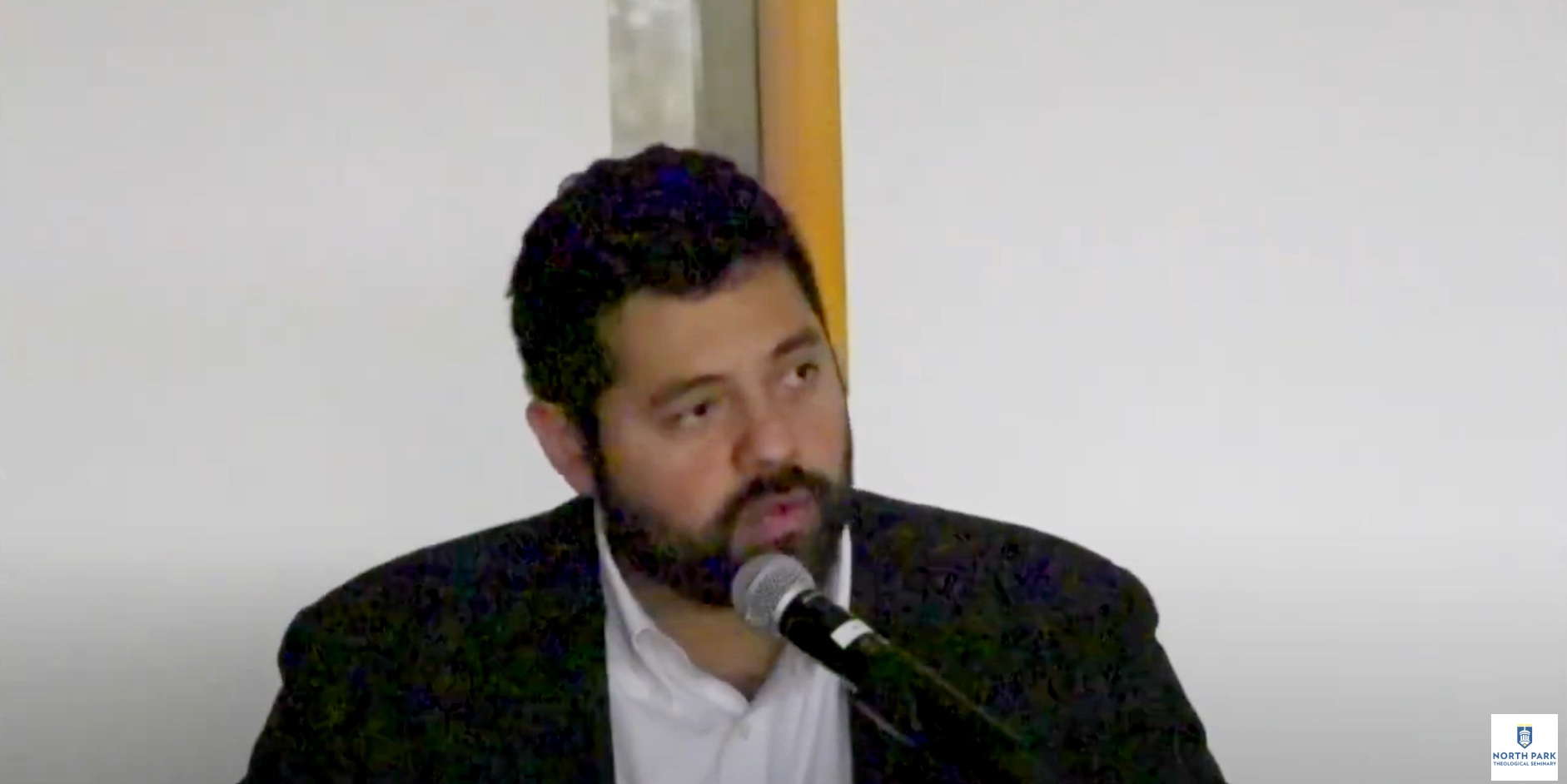
The following presentation took place at the 2025 Symposium for the Theological Interpretation of Scripture: Hospitality & Immigration on North Park University’s campus in Chicago, IL on February 14 and 15, 2025.
In Session 3, Albert La Rosa Rojas begins by exploring what it means to speak of a “theology of home.” He emphasizes that home is not merely a structure or legal claim but a theological reality found throughout Scripture. The biblical stories of exile and return—whether in Israel’s desert wanderings, the Babylonian captivity, or the New Testament vision of a church scattered in diaspora—show that God’s people have always lived with unsettledness. For Albert, these texts remind us that belonging is not limited to nationality or citizenship; instead, home in God’s story is relational, shared, and rooted in community.
Albert then turns toward contemporary immigration debates, noting how public discourse often frames migrants in terms of threat, security, and exclusion. Against this backdrop, he argues that theology offers a counter-narrative: one that refuses to define people by their displacement and instead insists on the call to welcome and solidarity. This vision does not erase the political realities of borders and laws but places them within a larger theological horizon, challenging Christians to see home as both gift and responsibility.
Armida Belmonte Stephens builds on this foundation by pressing the ethical implications more directly. For her, the theology of home demands that faith communities practice hospitality in tangible, even costly ways. To imagine home as God intends is to create spaces of safety for the vulnerable and to recognize that Christians are called to welcome strangers, not as outsiders, but as participants in a shared story. While she acknowledges the tensions and difficulties that arise in a world of restrictive policies, Armida urges listeners not to retreat into fear or defensiveness. Instead, she concludes with a hopeful challenge: to reimagine home not as a fortress to be guarded, but as a space of love, belonging, and responsibility that transcends boundaries.
Timestamps
-
Introduction and framing: what is a “theology of home”? 0:00 – 5:00
-
Biblical narratives of exile, home, and return 5:00 – 15:00 ·
-
Theological reflections on belonging and identity 15:00 – 25:00
-
Immigration debates and competing political narratives 25:00 – 35:00
-
Ethical responsibilities: hospitality, care, and solidarity 35:00 – 45:00
-
Tensions and challenges of living faithfully amid borders 45:00 – 55:00
-
Conclusion: imagining home as shared space and hope 55:00 – end
SHARE WITH FRIENDS