


This sermon was preached in Isaacson Chapel at North Park Theological Seminary community worship, October 23, 2025.
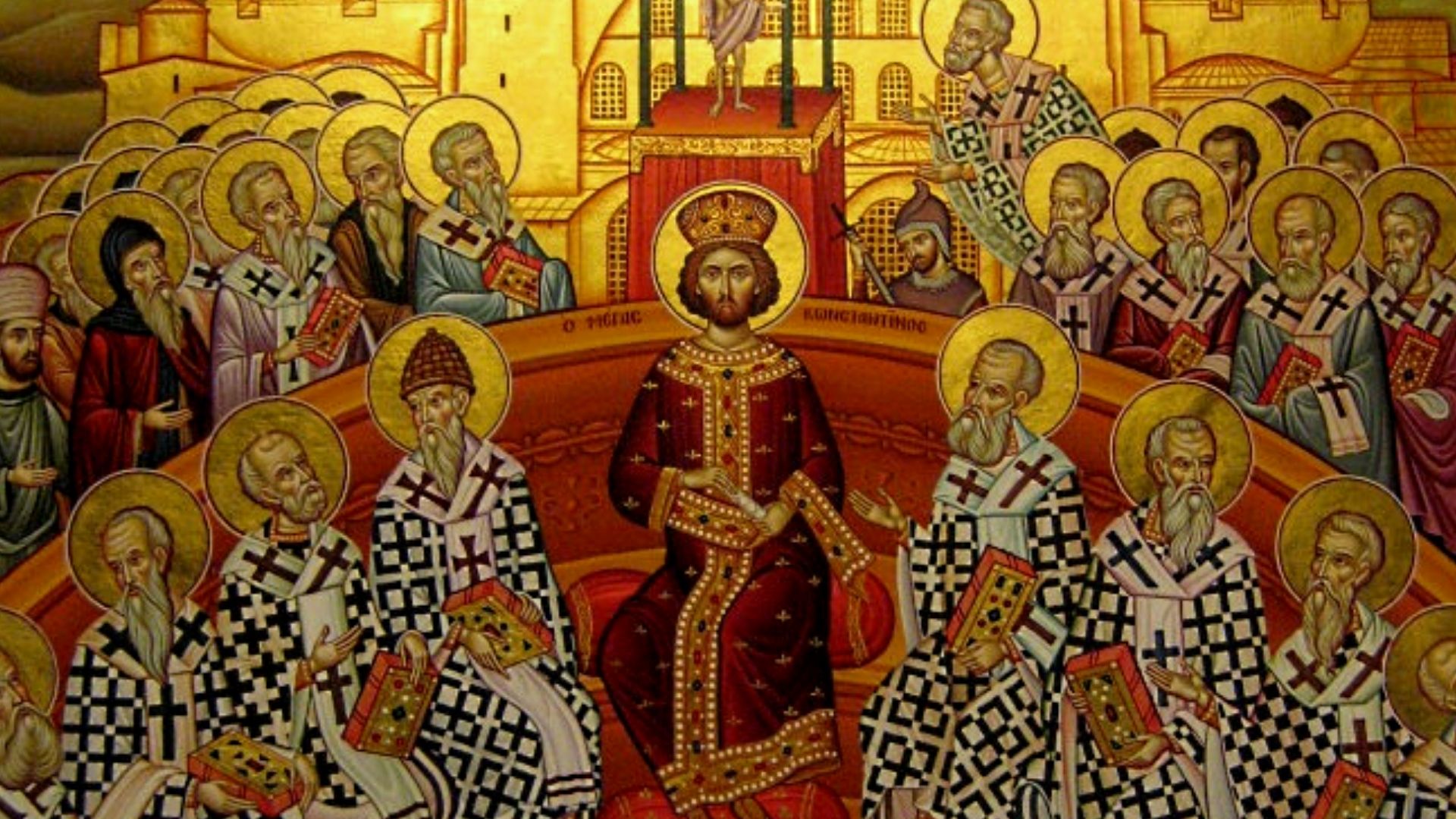
Because I’m not teaching History 1 this semester, I couldn’t resist the temptation to begin with an early church pop quiz: which student can tell me the year of the Council of Nicaea?
That means that 2025 marks the 1700th anniversary of the Nicene Council and Creed. I’ve been working on an exhibit to mark the 50th anniversary of the Covenant’s vote to ordain women. Dean Edwards was working on celebrations of the 500th anniversary of Anabaptism. But 1700 years? That’s difficult for us American evangelicals to wrap our minds around.
For one thousand seven hundred years, every major Christian tradition has affirmed this statement of historic orthodoxy. While no doubt you’ve been celebrating individually across the year, I couldn’t let 2025 end without marking in our communal worship the only centennial anniversary of Nicaea that will occur in our lifetimes.
In my church, every Sunday sermon is followed by the congregation standing and confessing together the Nicene Creed. For me Nicaea is the most grounding, beautiful summary of the gospel, of God’s saving self-revelation, self-giving in human history. For me reading Scripture with the champions of Nicaea—inhabiting the devotional worlds of figures like Irenaeus of Lyon and Athanasius of Alexandria—continually restores my vision to gospel-sized proportions from the various reductions and depletions of our own time.
And yet. As I’ve tried to sit in the ancient world of Nicaea this week, my mind has been continually pulled back to the burdens of today, my heart heavy with daily accounts of neighbors taken without due process; the erosion of democratic norms, constitutional safeguards, and public discourse; the normalization of overt racism, xenophobia, and misogyny. I’ve been weighed down by anger over unexpected deaths, incomprehensively early and untimely, the layering of tragedies too much to bear. I’ve felt more resonance with the imprecatory Psalms than the prologue of John.
I know that in times of acute, persistent, and compounding injustice attention to an ancient creed can seem tone deaf, or maybe escapist. I suspect I’m not alone in feeling the tension of attending to careful study while it can feel that the world is burning.
But I want to encourage us as a learning community to resist the temptation to collapse a real tension into an easier binary—I want to encourage us to reject this either/or as a false alternative. It is and has always been precisely for the urgent needs of the world that we need sound theology.
In Matthew 16:15 Jesus asks his disciples, “Who do you say I am?” This is the question of Nicaea, and it is the question for every generation of Christians. It is the question for us today.
As harmful policies are celebrated as a restoration of Christian values—as so much injustice and bullying bravado are tied perversely, idolatrously to the name of Christ, our answer to Jesus’ question matters urgently. “Who do you say I am?”
The second century bishop of Lyon, Irenaeus, used the image of a mosaic to describe the relationship between Scripture and the rule of faith. When the full account of Scripture is read through the structuring, ordering principles of the church’s rule of faith, it reveals a beautiful portrait of a king. Irenaeus compares the gnostics of his time to those who take the same tiles but rearrange them. As a result, mosaic reveals not the king but a fox. Though the gnostics use the same components of scripture – terms, themes, whole verses – because they do so without the framework of the church’s rule of faith, they don’t offer the same gospel.
The creed matters, not as philosophical play but as a safeguard to ensuring we are answering Jesus’ question faithfully, in continuity with the apostolic witness. A safeguard to ensuring that the gospel we proclaim is a gospel that saves.
It’s frequently the case that things presented as new or novel are as old as human nature, while things presented as traditional are often relatively recent developments. So, when a 1700-year-old confession remains a standard of historic orthodoxy sustained through so many subsequent divisions in the church, we should pay attention to it.
How is the scriptural structure of Nicaea good news for us today? How does it help us to faithfully answer Jesus’ question, “Who do you say I am?” I want to suggest two ways it might do so.
First the creed insists that the God who creates is the God who redeems. The creed begins, “We believe in one God, the Father, the Almighty, maker of heaven and earth, of all that is, seen and unseen.” The church not only believed that its worship of Jesus was not in violation of Jewish prohibitions of idolatry and command to monotheism; it further asserted that the divine revelation in Christ was the fulfillment of God’s revelation to and through Israel: “Then beginning with Moses and all the prophets, he interpreted to them the things about himself in all the scriptures” (Luke 24:27).
This was not a given.
In the second century, Marcion was a Christian leader, the son of a bishop, who attracted many followers with his teaching that the God revealed to Israel and depicted in its Scripture was an inferior god who created the material world. Capricious, jealous, and judgmental, it is this second-order deity who makes demands, sends plagues, and smites enemies. By contrast, Jesus came to reveal the true God—his loving Father who does not sully himself with the matter—and through this revelation to save humanity from its material bondage. The God who redeems is not the god who creates; rather, for Marcion, God through Jesus redeems us from created matter.
Against Marcion the early church insisted upon the continuity of creation and redemption, affirming one God, revealed to Israel and incarnate in Jesus, and that this one God is both creator and redeemer. “We believe in one God, the Father, the Almighty, maker of heaven and earth, of all that is, seen and unseen.”
The implications of the early church’s commitment to continuity are enormous.
First, against the anti-materialism rife in this context, the church insisted that all that God created was good; the fall was not a fall into material reality but rather the corruption of the entire cosmos—material and spiritual—through disconnection from God, the creator and sustainer of life. Salvation in Christ therefore does not liberate us from an evil creation but from the corruption of the good creation, restoring us to communion with our creator and restoring heavens and earth. This consecrated human life and all created matter. As John of Damascus exclaimed, “I do not worship matter; I worship the Creator of matter who became matter for my sake, who willed to take his abode in matter; who worked out my salvation through matter. Never will I cease honoring the matter which wrought my salvation!”
Secondly, the church’s rejection of Marcion preserved the unity of Scripture—that the Old Testament is Christian scripture against Marcion’s alternate canon. We cannot minimize the hermeneutical challenges Marcion and many others before and after him experienced with the challenging texts and anthropomorphisms of the Old Testament. But what Marcion saw as petty judgement I am holding on to—humbly but tightly—as assurance that our God is a God of justice. It enables me to bring to God the words of the Psalmist in all my emotions. This week I’ve been sitting with Psalm 94 “Can a corrupt throne be allied with you—a throne that brings on misery by its decrees?” (v. 20), and taking refuge in the divine justice promised in conclusion, “He will repay them for their sins and destroy them for their wickedness; the Lord our God will destroy them” (v. 24).
Not only does the creed protect the unity of divine revelation in Israel and in Christ, the one God who creates and redeems. It insists upon the utterly astonishing method of redemption in the incarnation. The creator of all things entering his creation, becoming a creature, assuming all of human nature, its limitations and vulnerabilities—ultimately suffering and death.
For the ancient mind, this is absolute bananas. It was incomprehensible on the face of it that the all-powerful, unchanging divine could or would take on the limitations, the indignities of material human life. And many early Christians sought to soften the scandalous claims of the incarnation a as they answered Jesus’ question, “Who do you say I am?” In the bluntest version some said Jesus only seemed to be human but in fact was purely divine. More subtle versions included Arius’s teaching that Jesus was divine, but slightly less divine than the father, the first born of all creation before time.
The creed rejects these easier alternatives, insisting on the reality of divine condescension we find in Philippians 2, where Jesus, “though he existed in the form of God, did not regard equality with God as something to be grasped, but emptied himself, taking the form of a slave, assuming human likeness” (vv. 6-7).
The Nicene Creed proclaims that the one through whom all things were made, God from God, Light from Light, true God from true God, begotten, not made, of one being with the Father became incarnate, was crucified, suffered death and was buried, rose again, ascended to the right hand of the father, and will come again, and his kingdom will have no end.
Where does the divine condescension of the incarnation scandalize us today? Are there temptations we face to rationalize, qualify, or tame the astonishing gospel of the cosmic creator who redeems and transforms all of creation by himself entering it, being subject to its injustices and in the resurrection and ascension conquering all evil and healing all that’s broken.
Our proclamation matters. Not for heresy hunting or self-righteous piety but for the church’s faithfulness to our call to speak about God and to God as truly as possible. Of bearing witness to the fullness of the gospel of divine condescension passed down to us by the apostles that in Christ God is making all things new. That Christ is king and at his name every knee will bow and every tongue will confess his Lordship.
Our proclamation matters—and it is authenticated by action. Justin Martyr insisted, “let those who are not found living as [Christ] taught, be understood to be no Christians, even though they profess with the lip the precepts of Christ.” Early accounts of “the peculiarities of the Christian society,” observe Christians’ honesty, egalitarianism, and responsive care for one another, especially their most vulnerable members: widows, orphans, and the poor. Their pooling of resources to provide burials, bring food to prisoners, and pay for their release if possible. Tertullian claimed that outsiders observing the actions of the Christian community would exclaim, “See how they love one another.”
We answer Jesus’ question in our proclamation of word and in deed, in individual and communal actions that bear the fruits of the Spirit. “See how they love one another.” Stanley Hauerwas writes that orthodoxy, “does not require coercion to sustain itself. Rather orthodoxy is displayed as an act of love that takes the form of careful speech” (p. x) and “the testing of Christian speech is prayer” (p. ix). So, let’s continue our proclamation in confession and prayer. Please stand and join me in the words of the Nicene Creed:
I believe in one God,
the Father almighty,
maker of heaven and earth,
of all things visible and invisible.
I believe in one Lord Jesus Christ,
the Only Begotten Son of God,
born of the Father before all ages.
God from God, Light from Light,
true God from true God,
begotten, not made, consubstantial with the Father;
through him all things were made.
For us men and for our salvation
he came down from heaven,
and by the Holy Spirit was incarnate of the Virgin Mary,
and became man.
For our sake he was crucified under Pontius Pilate,
he suffered death and was buried,
and rose again on the third day
in accordance with the Scriptures.
He ascended into heaven
and is seated at the right hand of the Father.
He will come again in glory
to judge the living and the dead
and his kingdom will have no end.
I believe in the Holy Spirit, the Lord, the giver of life,
who proceeds from the Father and the Son,
who with the Father and the Son is adored and glorified,
who has spoken through the prophets.
I believe in one, holy, catholic and apostolic Church.
I confess one Baptism for the forgiveness of sins
and I look forward to the resurrection of the dead
and the life of the world to come. Amen.
SHARE WITH FRIENDS