


Two Decades Later: North Park Theological Seminary Female M.Div. Graduates (1977-1997)
April 6, 1998

Isolde Anderson

This year, 1998, marks the twentieth anniversary of the ordination of women clergy in the Evangelical Covenant Church. From a handful of pioneers in the late 1970s, the number of female clergy has increased significantly. More women are attending seminary than ever before. Women are involved in a greater variety of ministries. Of those involved in pastoral ministry, several have received second and third calls to churches. What has been the experience of our denomination in training and placing women in Covenant ministry during this period? Where have we been successful, and where do we need to improve?
Ten years ago a survey was done of female Master of Divinity graduates of North Park Theological Seminary (NPTS) and the results were published in the Covenant Quarterly. 1Mary Miller, “A Decade Later: North Park Theological Seminary Female M.Div. Graduates (1977-1987),” The Covenant Quarterly Vol. XLVI, No. 4 (November 1988), 6-26.That study compared the ten-year history of women NPTS graduates with the Covenant’s 1976 “Statement on the Ordination of Women.” Among its key findings was that a significant number of female pastors had left the Covenant to find jobs in other denominations. Many females had experienced gender discrimination by conference superintendents and local churches in the placement process. On the other hand, women also experienced affirmation of their gender because of the greater visibility it gave them in the job search; it was frequently viewed as an asset in chaplaincy, and it helped them develop an inner strength and identity.
Several suggestions for improving understanding and support were offered in the summary of the study, including the need for (1) policy changes in the denomination to prohibit gender discrimination in clergy hiring practices, (2) clear denominational leadership on the issue of women in ministry, (3) development of an educational program for local churches on the issue, and (4) greater exposure of churches to women clergy. The study concluded, “Spoken and unspoken tensions and hopes have lived side by side as history has been written. Given the revelations of this study, what will the picture be in another decade?”2Ibid., 19.
A New Questionnaire
That closing question now introduces the findings of a new study on the placement experiences of NPTS female M.Div. graduates since 1977.31998 Covenant Quarterly Survey: What year did you graduate from North Park Theological Seminary? With what degree? What was your church membership upon entrance to North Park? What is your present church membership? Are you ordained? As of March 1, 1998, are you presently serving a Covenant church? If yes, what is your job title? Part-time or full-time? Is this a church in which you were a layperson before earning your theological degree? Are you presently serving a church of another denomination? If yes, name of denomination, job title, part-time or full time? If not serving a church in a pastoral role, please indicate what work you are doing at the present time. When you graduated from North Park, did you place your name in process for a pastoral call in the denomination? If no, indicate the reasons: Decision to enter specialized ministry Change in job interest Anticipated difficulty in the Covenant’s placement process Theological differences with denomination Other Please list contacts you had from Covenant churches in the first year after graduation during the placement process: Phone calls from conference superintendents Phone calls from church members Phone calls from search committees Meetings with church search committees Meetings with congregations Senior pastor of church needing multiple staff Phone call from pastor near the open church who called to inform you of opening Other What work have you done since graduating North Park? Paid/unpaid? If you have served in more than one church since graduation, how would you compare the second or third placement process with the first? Easier/harder/other? In what ways? If you were a member of the Covenant upon entering North Park but are not a member now, please circle some of the reasons for your change: theological differences, inability to find placement in a Covenant church, change in career goals, more support for women in ministry elsewhere. Comments… If appropriate, describe how placement as a woman has been either easy or difficult for you. Mark an X where you perceive the Covenant’s relationship to women in ministry to be: Negative ___________________________________________________________ Positive If you had a magic wand, what would you do with it to aid the progress of women in ministry in the Covenant? Comments of encouragement and/or discouragement. Name (optional). Date. The new study used all of the questions contained in the 1988 survey, with a few modifications, including some wording changes and greater development of response categories. The new survey also added two new questions, which take into account the twenty-year potential work history of the respondents. These new questions inquire about the full spectrum of work women have done since graduating from seminary and, if they are in pastoral ministry, how their second or third job search compared to the first.
In the 1988 survey, North Park Theological Seminary graduates were selected for study because of the seminary’s focus on Covenant students and involvement in the denominational placement process. The 1998 survey likewise focuses on female M.Div. graduates, not only for the reasons given above, but also for purpose of comparison. The survey sample does not include orientation students, women who transferred from NPTS to other seminaries, women who graduated from NPTS with other degrees, women transferring their ordination standing to the Covenant from other denominations, or male students who graduated during this period. These groups would be profitable to include in a future study. The survey is, therefore, a qualitative, not quantitative, analysis of one segment of the potential clergy population of the Covenant.
The hardest task was to acquire from North Park University and the Department of Ministry an accurate and complete list of M.Div. graduates.4Thanks to Lenore Knight of NPU and Lindsay Armfield of NPTS, who researched school records, and to Dotty Anderson in the Department of Ministry for supplying some current addresses. In addition to the names and addresses supplied by these sources, I received further leads from other women clergy about seminary graduates whose names did not appear on any “official” list, generating a mailing list of sixty women.5This list is still incomplete. Any NPTS female M.Div. graduates who did not receive the questionnaire are encouraged to mail their names and addresses to Isolde Anderson so we can update our records. All were sent questionnaires. Follow-up postcards were sent to those who did not respond by the original due date. In total, thirty-eight women sent back surveys. One response was hand-written and did not use the form supplied.
Profile of Respondents
Of the thirty-eight respondents, two were not M.Div. graduates of NPTS, but orientation students. Their comments (but not personal data) are included in the interpretive section of this paper and so noted. Of the M.Div. graduates, four had specialties: two in urban ministry (Seminary Consortium for Urban Pastoral Education) and membership in Covenant churches before attending seminary, four were members of other denominations, one was not affiliated with any church, and one did not indicate her affiliation. Currently twenty-nine still hold membership in Covenant churches, four are with other denominations, and three are inactive or not members of any church. This contrasts with the 1988 study, in which seven respondents (out of twenty-four) had left or were in the process of leaving the Covenant. Thirty of the 1998 respondents are ordained (UCC, ELCA, Latvian ELCA, ECC); six are not.
Where Are They Now?
The most significant numerical shift occurs in employment history. Of the thirty-six M.Div. graduates, only thirteen are currently serving in Covenant churches. Of these, four are part-time employees. Twenty-three are not employed in Covenant churches. Of the twenty-three not serving in Covenant churches,
Four are working as chaplains in Covenant institutions
Four are working as chaplains (military, institutional) outside the Covenant
Three pastor churches within other denominations or independent churches
Two hold administrative positions with other denominations
Two are career missionaries with the Covenant
Two are in social services
One is no longer working
One teaches at a Covenant institution
One is a substitute teacher
One is a retreat facilitator, writer, and artist
One directs a food pantry
One works in retail business
The data above show that only 25 percent of female NPTS M.Div. graduates are currently full-time pastors. Eleven percent are part-time Covenant pastors; 8 percent are pastors of non-Covenant churches; 22 percent serve as chaplains; 5.5 percent are denominational administrators; 5.5 percent are missionaries; 22 percent have found or created alternative jobs for themselves, many of which utilize their pastoral gifts. Without having similar statistics for male graduates, it is impossible to make accurate comparisons of placement results. However, it is highly likely that more than 25 percent of male NPTS M.Div. graduates of the past twenty years are employed full-time as Covenant pastors. Again, this warrants further research. Further, it is important to note that at the time of graduation, twenty-two women (61 percent) placed their names in process for a pastoral call. Of the fourteen (39 percent) who did not place their names in process for a pastoral call, four were already planning to enter a specialized ministry, three others had positions already offered to them before graduation, two were leaving the Covenant for another denomination, two were waiting for husbands to graduate from seminary, one was preparing to go to the mission field, and one was not sure about her job interests at that point.
Leaving the Covenant
Unlike the profile in 1988, only four of the women who responded to the 1998 survey have left the Covenant.6Of the twenty-two who did not respond to the survey and the four who responded anonymously, eight are ordained in the Covenant (one is inactive, one serves an independent church), seven hold some form of ministerial license with the ECC, six are not licensed for ministry, three have left the denomination; the status of the others is unknown. One of them was already affiliated with another denomination before entering seminary. Another left for theological reasons. She explained, “Had it not been the case, I would’ve stayed and ‘gutted it out’ to deal with the practical problems.” Two others left because of inability to find placement in Covenant churches, as well as discovering more support for women in ministry elsewhere. Both are now solo pastors in non-Covenant churches. One wrote, “Getting a job was impossible. When you graduate, you have loans to pay off. I waited two years (nearly in poverty) to get a Covenant job before forging a path to the [new denomination].” The other wrote, “Whereas I am a proud and grateful graduate of NPC and NPTS, I sometimes feel like a casualty of the denomination. At seminary, I experienced a tremendous amount of support and nurture. However, I was bewildered in the placement process. The only interviews I had were for Christian education positions with pay horrifyingly low… I found the ‘upper leadership’ of the denomination most resistant… I left the Covenant because I felt little support for my call… with the exception of a very few friends, NPTS, and my internship church.”
Several others who responded to the survey are still affiliated with the Covenant but are contemplating leaving. One woman, not currently serving in a church, wrote, “If I ever leave the Covenant, it will be first because of a lack of support for women.” Another, serving in a church part-time, wrote, “It’s been three-and-a-half years since graduation and I’m still scrambling… I’m running out of places for several different reasons… moving out of the Covenant is looming larger.” A third graduate, not employed in a church, wrote, “My disenchantment with the Covenant was finalized a few years ago after I’d asked them to please mail some information to the Presbyterian Board of Inquiry at a time when I was considering a denominational move. They complied and then proceeded to address me as ‘Mrs. [John Doe]’ or ‘Mrs. [Jane Doe]’! Where the previous title of ‘Reverend’ went, or why, was an interesting point of development and simply added to all the other inappropriate decisions and neglects.” Another, in the search process for a year, writes, “I have received no support, no calls, no nothing from the Covenant. I am seriously considering moving into another denomination.”
Still others have equally painful experiences, yet cling to the denomination as “home.” For some, the support and encouragement of peers gives them affirmation and a sense of belonging. For others, the amount of time and prayer they’ve invested in the Covenant is too precious to lose. One woman, seeking a pastoral position, wrote, “I have been in the Covenant Church for twenty-two years. I figure that God called me to this denomination for a purpose that was more than just strengthening my patience and character, as I have waited a total of nine years for calls to Covenant churches.” Still another (who grew up in the Covenant) lamented, “The Covenant has no place for me. I have had to find my place in the Covenant. I will not leave my ‘home’ because of rude and ignorant men and women. I am valued as a person in my profession and have been actually honored several times. I have gifts that the Covenant will probably never seek to use. And I have found peace in acting locally.”
The Placement Process
Of the twenty-two women who placed their names in process for a pastoral call, fewer than half received inquiries from superintendents, other pastors, or churches. Eight received phone calls from conference superintendents. Of these, two women said they were called only after they initiated the contact. Three received phone calls from church members. Ten received phone calls from search committees and nine actually met with search committees. One woman who was contacted by a search committee said, “The committee was not interested in me, but wanted my expertise in finding someone else.” Nine of the graduates were contracted by the senior pastor of the church seeking staff. Two received phone calls from other pastors informing them of an available job. Seven indicated other contacts. These included staff ministers making contact with the graduate, the seminary dean introducing the graduate to a pastor he knew who was seeking to a hire a staff person, and finding out on one’s own that a church was looking for an interim pastor and applying for the position.
Several of the women acknowledged the candor of certain superintendents who, in the interview process during senior year, told them to anticipate difficulties in placement. Others had more distressing encounters: “[Some of the superintendents] didn’t even ask me about my call or gifts—instead, how I like being married… One asked how long I’d be willing to wait for a call in the Covenant, and I answered, ‘I only have one lifetime.’”
As expected, the placement process was experienced differently by the various respondents. Of those whose experience was largely positive, there were two main contributing factors. One was the presence of an advocate or a motivated search committee. One part-time pastor writers, “My mentor and senior pastor, Swedish Lutheran (ECLA), really wanted me to work with him and convinced the church it would be good for all parties.” An associate pastor writes, “[Placement was] easy due to male colleagues who served as advocates. However, without this advocacy I doubt I would have a call even though I’ve received two inquiries to move to other churches.” A woman with pastoral experience in several churches says, “In my first call, my predecessor took the initiative in preparing the congregation for the possibility of calling a female pastor. He did so by leading a biblical study of women in ministry, by inviting a woman seminarian to supply the pulpit, and through quiet advocacy. The search committee, therefore, was prepared to receive and to consider seriously my profile when the superintendent presented it to them.” Yet another pastor, recently called to a church, wrote that the search committee “did an exceptional job preparing the congregation to entertain and vote on a woman candidate… Maybe the process [we] went through could be a model for other Covenant churches.”
Another factor contributing to positive placement experiences was the uniqueness of being female clergy. One pastor wrote, “In my interview during the candidating weekend, one of the members of the committee reminded the others of a neighboring congregation’s positive experience with a woman pastor, saying, ‘If they can, so can we.’ When the time came for a decision, the congregation voted overwhelmingly, although not unanimously, to extend the call to me.” One of the orientation students, employed as a staff minister in a Covenant church, wrote that placement as a woman “has not been an obstacle at all.” Another pastor, with extensive experience, reflected that it was “easier. I was identifiable, unique, had contacts throughout the Covenant. [On the other hand] no congregation seeks a woman as their pastor, but has to be persuaded and then test the woman out.”
Some of this positive attitude toward the female gender carries over into other cultures as well. One missionary writes, “Where I serve, a new national church organization was born/established in December of 1997. This organization… has already in its first meeting decided that women can be ordained. Not only that, but they also elected a woman as the president of the national board. In a Latin country and for the first meeting, that is incredible!”
However, after twenty years there are still numerous obstacles hindering women in the placement process. One is geographic location. If a female needs to remain in a certain area while her husband finishes school or after her employment with a church is terminated, it is often difficult to find work in another Covenant church nearby. This holds true for male clergy as well.
Second, clergy couples often experience unique challenges in the placement process. One might expect it to be easier for a woman to get a job “through her husband,” but often her gifts are not validated in the process. One co-pastor explained that she did not go through the interview process, but that some superintendents told her, “that I should volunteer my services to my future husband’s church, since it was a shame for him to leave the church [so we could find a co-pastorate elsewhere]. However, a couple of superintendents were excited about [him] and me as a team in the future.” Another co-pastor wrote that “being a clergy couple provides a challenge. When looking for placement, churches look first at my husband who has led… more years of experience.”
A third obstacle is discrimination. Some women graduates have experienced discrimination from conference superintendents. “Only one time did I ask the superintendent for a church. I was willing to go a great distance. His word to me has echoed in my ears a long time: ‘There is no place for a woman in ministry in [this state].’ I asked for my name to be given by the previous superintendent for [Church X]. It never was. And a lady on that committee said my name was never even given. So helpless, to be invisible, yes I was.” A staff minister identified hidden opposition within the local church as a difficulty. “I feel I had conference and church support in my placement. My difficulties have arisen out of members within the church who have other backgrounds (Moody Bible Institute) who demonstrate through [speech] and attitude that they do not submit to my pastoral authority.” Others have experienced more overt sexism. One woman, not currently serving in a church, claims, “Churches don’t want a woman [pastor] with a young child or with more than one child.” Still another wrote, “I learned from the conference superintendent that because I had a baby and was forced to resign my job that my name had been taken off the pastoral eligibility list for one year without my knowledge or consent!” Gender discrimination is perceived not only by pastors in the United States, but by some missionaries as well. One wrote, “The Japan Covenant Church seems to ‘handle/place’ single women pastors okay, but the cultural expectations on married moms GREATLY changes things.”
A fourth obstacle is the struggle to develop an appropriate pastoral role for oneself. While this is a concern for both male and female clergy, it is particularly important to women entering a predominantly male profession. The lack of female role models and the limited types of traditional church positions (pastor, associate, youth minister) constrain women in the full development of their gifts. An astute graduate observes, “My gifts don’t naturally fit positions acceptable for women in the Covenant so I feel these are not looked at and I don’t have the opportunity to develop these and gain experience. Superintendents don’t shoot straight with me. When I’m offered placement as a pastor (solo, etc.) it’s only been at a dying church or one that had eaten several pastors alive.” One of the graduates in the early eighties said placement “was impossible for me. I was told by one superintendent that I ‘was not political enough.’ As I look back now, I am aware that I was not assertive enough. I was too much of a fifties type woman—nice, quiet, and did not speak my mind. I also did not have a mentor. That would have helped. Nor had I defined what my call to ministry meant to me. Or what I believed my gifts for ministry consisted of. In other words, I had not developed a voice. And certainly in the Covenant I needed a voice and words to have found my calling to ministry. The Covenant did not have security in itself to allow a woman time to develop her ministry, or to find her voice and her words.” Still another is finding it difficult to branch out into other areas of ministry: “After several years in chaplaincy, I resigned due to cutbacks in our CPE program. I put my name in the placement process [for a church] and have heard nothing for a year.” Even when filling a ministry position, a woman often encounters congregational skepticism, e.g., can she be a capable youth pastor? Is a competent leader? Will she be as committed to ministry once she has children?
Second and Third Placements
Ten years ago the perception of those seeking a second call to a ministry position was that the process was as difficult, or even more difficult, than the first. In the ensuing ten years the perception has become more optimistic. Of the thirty-eight respondents, seventeen shared accounts of second or third placement experiences. Three of the most positive responses were from women who left the Covenant and found employment in other denominations. Of the fourteen remaining in the Covenant, several have happily secured second positions. One pastor wrote, “I think both placements were open—especially because the positions were staff, not a senior pastor or solo position.” A chaplain wrote that the second placement was “easier in that I am better known and more self-confident.” Several attributed their success to working independently of the superintendents and Department of Ministry. One woman wrote, “The two placements I’ve had were both easy once I got in the right place and. Made the contacts… I have never gotten any of my jobs through the system. It has not worked for me. I do not see this as changing either. My jobs have come as a result of my working to make my own contacts.” Another, more recent, graduate remarks that for her, “contacts came quite out of the blue. No superintendent has been directly involved and I think that has served me well.” Some women, however, found a superintendent to be very supportive: “The invitation to the third call went well and came more quickly than I had expected. The superintendent of the conference in which the calling church is located was helpful in facilitating conversation between me and the search committee.” Women who co-pastor churches with their husbands generally found second placements to be no more difficult than the first. Several women also claimed that networking helped them make the transition to a second job. One orientation student said that because of her contacts, she was asked to plant a new church. An associate pastor stated that she got her second position because she contacted a staff member at the open church and she knew the senior pastor from NPTS.
Among those encountering difficulty in the second and third placement process, several reasons were cited. One was resistance to women in more visible roles, such as senior pastor. One revealed, “My promotion to senior pastor was very difficult. Thirty-five members left as a result of the conflict… I crashed through the stained glass ceiling, but not without scars. But our church is a much happier, healthier place now.” Another reason for placement difficulty was the perceived barrier of being the first woman in a particular position. “It has been thirteen years since I have ministered in a church in which I was the first woman pastor. It’s a lot easier to be the second or third.” For some women, it is difficult to get recognition for specialized ministries such as urban outreach or crisis counseling. And then there is the reality that fewer “second” jobs exist, and the wait to get such jobs is correspondingly longer. For one pastor, “The second placement was harder in that I was under pressure to move on by a certain time and was told that if I didn’t get placed it would be really hard to get a job.” Another admitted, “It took four years to receive a call to the third and last Covenant church I served.” Still another said, “It took a long time for a viable option to be presented to me as a second call—more than eight years. Once the contact had been made, however, the process went well.”
Varieties of Gifts… Varieties of Service… Varieties of Working
In 1 Corinthians 12:4-6 the apostle Paul describes the spiritual gifts given to the people of God this way: “Now there are varieties of gifts, but the same Spirit; and there are varieties of service, but the same Lord; and there are varieties of working, but it is the same God who inspires them all in every one.” The truth of this passage is clearly manifested in the lives of the thirty-eight respondents. Of this group, only eleven have been employed in church-based, pastoral ministry ever since graduating from NPTS—nine in the Covenant, two in other denominations. Several more have worked as chaplains the entire time since graduation. Two are missionaries. Most have sought other service occupations—teaching, pantry ministry, administration—to utilize their gifts. The resourcefulness of these graduates is evident in the job choices they have made even when doors to churches have remained closed.
Flexibility is another characteristic of this group. Some have pursued further study while awaiting a call to ministry. Others have worked to put their husbands through school. Some have shifted between various ministries, such as from working with youth to working as chaplains. Two serve as visible leaders in other denominations, one as the newly elected director of a D.Min. program in a seminary and the other as director of a national department of evangelism. Some have taken time off from ministry after having children, while others have continued in their professions as working mothers. Some have worked part-time or have ministered as volunteers. They have used their manifold gifts in a variety of service. As one graduate (not working in a church) wrote in her response form, “I resort to my own personal conviction and Scripture: Romans 11:29, ‘For the gifts and the call of God are irrevocable.’ There are the gifts of passion for the Word and for the Church. There are also gifts developed in the course of ministry. The gifts and the call are still with me. They are expressed creatively outside the church.”
The Covenant’s Relationship to Women in Ministry
The survey asked of respondents: “Mark an X where you perceive the Covenant’s relationship to women in ministry to be.”
Thirty-three responses were marked. Seventeen placed negative marks on the church, four marked zero, and twelve marked positive responses. Three responses of -0.5, +1.5 and +2.5 were rounded up to the next larger number in the bar graphs.
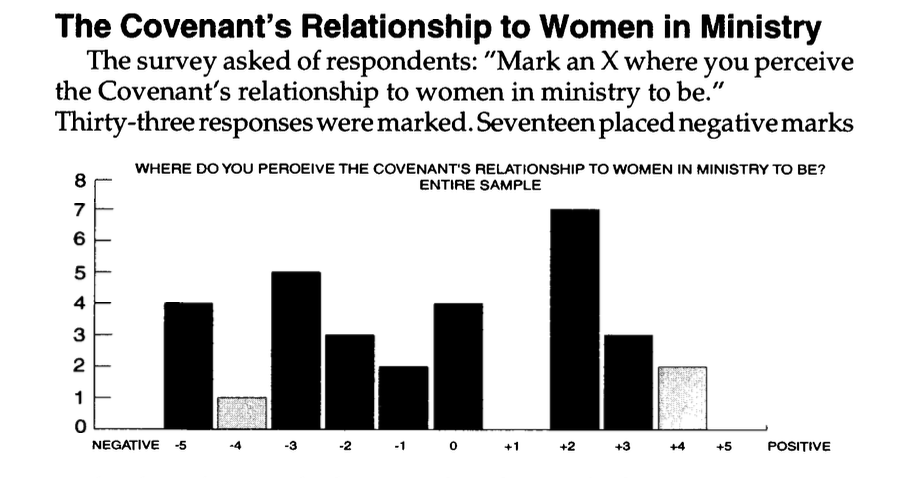
As expected, of the twelve women giving positive responses, all but one are currently employed in ministry. The one who is not currently in ministry has been a pastor in the past and hopes to find a new ministry position again soon. There is a clear correlation between employment rates and satisfaction with the denomination. Yet the majority (seven) of positive respondents fell into the cautiously optimistic quadrant (0 to 2.5). Only five were clearly optimistic (2.5 to 5).
While they are grateful for their own opportunities to serve Christ in ministry, they are also aware of the need for overall progress in the promotion of female clergy in the denomination. A chaplain wrote, “I think there are many who are supportive, especially in the ministerium. The downside is their voice is never heard or raised and there’s too much contentment with [not] rocking the boat.” A co-pastor wrote, “I think the Covenant has come a long way, but has a long way to go. I also think that there are some women who have a very easy time if they are well-liked, not picky, etc… but I think the Covenant overall could be doing better at the entire issue.” Of those who voted zero, all are employed in Covenant ministry.
Of the seventeen women giving negative responses to this question, ten are employed as pastors or chaplains (in the Covenant or other denominations), one is not working, one is in the search process for a pastorate, and the rest have found alternative employment. The majority of these women (twelve) fell into the clearly pessimistic quadrant (-2.5 to -5). An interesting finding is that among these twelve, seven are employed in ministry. Just like their more optimistic colleagues, they gratefully acknowledge their own opportunities while expressing concern for others. Five of the women were cautiously pessimistic.
Compared to the entire sample from 1988, there is a wider range of responses given in 1998, reflecting the increasing number of women who have experienced placement in ministry positions. In 1988 only three out of nineteen rated the Covenant’s relationship to women in ministry as positive. In the 1998 survey, twelve out of thirty-three rated it as positive. Still, that accounts for only one-third of all women graduates. Nearly two-thirds rated the Covenant at zero or below.
In the 1998 survey, the numbers shift slightly between the two decades.
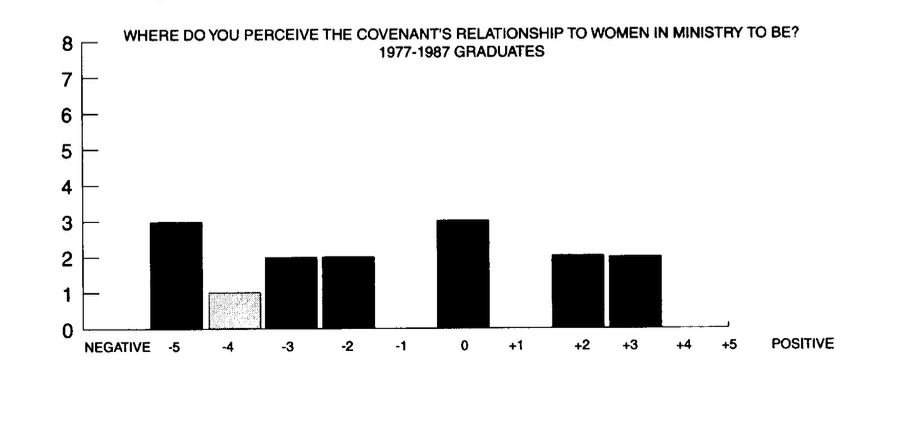
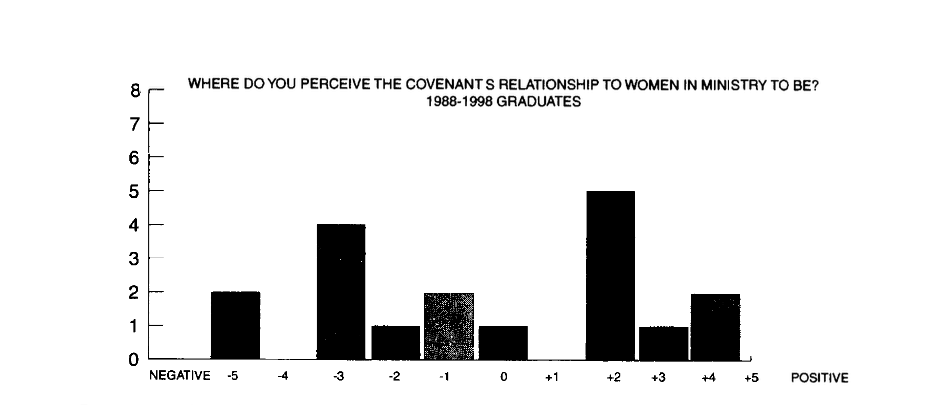
More graduates in the second decade are optimistic about the Covenant’s relationship to women in ministry than those in the first decade. In part, this reflects the fact that (1) all of those voting positive are employed in ministry, and (2) most are still in first-time ministry positions, not having experienced the potential stress and discouragement of seeking a second or third position as have the first decade graduates.
Their Concerns
The concerns women graduates express about the Covenant in 1998 have not changed substantively in ten years. The great majority voiced concern about the continued dichotomy between written policy and practice, promises and actual placement, seminary support and denominational resistance, collegiality with peers vs. suspicion from churches:
“The leadership is more supportive than the grassroots people are.”
“Lots of support on the seminary level… but the local church still has a way to go.”
“More verbal commitment than actual.”
Most respondents specifically mentioned their concern about the lack of teaching in Covenant congregations about the biblical basis for women in ministry, as well as the lack of strong support by denominational leaders on this issue. This perceived ambivalence of the Covenant toward women clergy plays out in many arenas:
“The once opened door has been shut to a crack in the present administration. Women pastors never are invited to speak to full assemblies [of the denomination]—only non-M.Div./ordained women in non-pastoral ministries.”
“My sense is that the Covenant’s affirmation of women in ministry is more intellectual than spiritual or practical. The Word says we are not to quench the Holy Spirit. When it comes to women in ministry, I think the Covenant is quenching the Holy Spirit. This is especially true in [a lack of] openness to women as associate superintendents, superintendents, and church planters. Where is it written that God has not called women to such ministries?”
“My sense is that the Covenant is in retreat. Denominational leaders appear to be unwilling to take a strong stance in support of women in ministry. Could they truly believe the struggle is behind us, or that it is unimportant? When was the last time our president addressed the issue in his newsletter to clergy or in missives to Covenanters, or superintendents in their letters to congregations? How careful is the Board of Ministry to question [male] candidates for ordination on their willingness to serve in a collegial relationship with women peers? If candidates are unwilling to support the Covenant’s decision to ordain women, how can they be ordained as Covenant ministers?”
This was the majority view of the respondents. However, two other concerns appeared in the responses, representing the extreme ends of the response spectrum. One pertained to the positive experience of women in ministry. Several women stated firmly, I have not experienced negative attitudes or comments while serving in a Covenant church,” or, “My experiences as an intern pastor in the United States and as an ordained missionary on the field and at home have been positive.” Another pastor urged the denomination to “keep the happy and ‘successful’ women out in front of people.” In actuality, many of the respondents experience the positive side of ministry. In their answers they frequently express gratitude for their calling and the affirmation they’ve received when allowed to use their gifts in the service of God. However, the frustrations are also real and to deny them does a disservice to the experience of dozens of women clergy. One chaplain wryly listed all the comments she’s received that attempt to disconfirm this aspect of women’s clergy experience: “I’m tired of this issue. Can’t we just let it rest?” “You must be a liberal feminist if you support women in ministry.” “Can’t we just talk about the gospel instead of issues?”
A second concern, reflecting a more extreme position, comes from those deeply disillusioned with the denomination. Their voices, too, should be heard. One former pastor, who was undermined by a toxic congregation, wrote, “I have been in a ‘resigned’ position for [several] years and can finally talk about this without crying. I felt such a deep sense of call. I was sure it would work. But it nearly killed me. I am glad to be alive.” Another former pastor stated, “I believe the Covenant to be a misogynist, sexist denomination; especially the elected leadership. I, sadly, have given up hope on the Covenant. I think women should be discouraged from pursuing an M.Div., unless they want to be chaplains or in specialized ministry.” Still another wrote, “I believe the Covenant Church and Ministerium sinned against its women who obtained their degrees.” The pain in these responses needs to be heard and validated as part of the full spectrum of experience of seminary graduates.
Suggested Interventions
“If you had a magic wand, what would you do with it to aid the progress of women in ministry in the Covenant?” This question was repeated verbatim from the 1988 questionnaire. One respondent quipped, “Speed up time twenty years.” Another conceded, “Magic won’t change sexism, only hard work by women and men working together.” Striking, however, was the consistency of answers between the two surveys. The 1998 survey reiterated all of the suggestions from 1988, only with added force. Obviously, not much progress has been made in ten years.
The wishes and suggestions fell into six groupings. The first was the need for change within the denominational leadership. After twenty years, the dichotomy between lip service and reality in the issue of placement of women in ministry appears more intentional and discouraging. A critical need is for elected leaders to offer strong and visible support on this issue. “Make sure anyone in a power position within the Covenant [is] fully supportive of women in ministry, a true and wiling advocate.” “Make it a priority, a passion burning in the hearts and minds of superintendents to educate search committees… on the merits [and] necessity of considering female candidates.”
Another pastor suggested bringing in outside consultants from denominations that have been more successful in placing women (such as the United Methodist Church) to train our superintendents to be more effective in presenting women candidates to churches. Another suggested a more broad-based approach. “I think the Covenant should hold a denomination-wide consultation on women in ministry, something on the order of the Consultation on the Cities held in November [1992]. Such a gathering would include denominational executives, superintendents, leaders of our educational institutions, and conference leaders, both clergy and lay, women and men, and of course, women clergy. The agenda would include storytelling, with stories of both sunshine and shadows, both the joyous and the painful, [and] a review of the current status of women in ministry. A major goal of the consultation would be to develop a denomination-wide strategy for the calling of women to pastoral positions in Covenant churches and for means of providing ongoing support to them in their ministries.”
A second set of suggestions called for a comprehensive educational program within the denomination on the biblical basis for women in ministry. This would include writing study guides for local churches, training people to lead workshops for churches (similar to Vision to Action and Evangelism Associates), providing continuing education for regional ministeriums, and requiring seminary classes on this subject.
A third suggestion was to plug the gap wherever possible. Even as women are educated in seminary and called to ministry, the Covenant experiences significant erosion of its accomplishments by allowing male clergy to undermine collegiality with their female peers. One pastor who left the Covenant wrote, “Don’t allow the circulation of a candidate’s profile unless he can give (teach) a biblical rationale for women in ministry and promise to teach this in every church.” This recommendation was seconded by a more recent graduate who commented that many of her male classmates were supportive of women in ministry but said “they never could stand up publicly for this or their church/family of origin/wife would all flip out.” Another pastor wrote, “Hold superintendents accountable for placing women.” Another insisted “that the Board of Ministry require ordination candidates to sign a statement (similar to the one on baptism) affirming the ordination of women.”
A fourth set of suggestions concerned how to make the placement process fairer. These included requiring superintendents to submit profiles of female clergy to every church seeking staff and streamlining resumes to make them gender-blind. “I would have a personal page with personal data and picture on a separate sheet. I’d have the remainder [of the profile] identify the pastor/student by social security number so there would not be a gender bias in the initial sifting process. Sometimes the best person for a job is a woman!”
While several respondents acknowledged that “there are some good role models out there,” another frequent suggestion was to expose local churches to more female pastors. One pastor wished, “I’d have hundreds and thousands of Covenanters experience deep, profound, loving ministry from a woman, Covenant pastor. Those who are so touched seem to change their negative attitudes into more positive, supportive ones.” A missionary wrote, “Help all the people in the churches to understand that it is God who calls us, and to disobey his call whether you are a man or a woman is to sin. We are all his servants, and people need to quit looking at the gender and start looking at the blessing that God has called another one of his people into full-time pastoral ministry and that they have answered that call by obeying.” A military chaplain wrote, “I have been assigned to two tours in which have been ‘the first woman,’ including my current role as command chaplain… Once people are exposed to a woman pastor, the fear dissipates. The key is exposure of any kind—interns, interims, pulpit supply.” Another pastor wished that “every church would have a woman preach at least twice a year so that people could become familiar with a woman in the pulpit.”
A new finding that did not appear in the 1988 survey is the clear recognition that the appointment/election of women to visible pastoral leadership in the denomination is long overdue. There was a frequent call for women superintendents and associate superintendents. “The Covenant needs a woman co-executive director of ministry.” “Half of all new ‘mission pastors’ should be women; half of all Covenant administrators should be women.”
After twenty years it is clear there is no documented strategy in the Covenant for promoting the cause of women in ministry. There is no one person responsible for advocating, mentoring, and monitoring the progress of women in ministry. In summary, the denomination is not structured to facilitate the acceptance of women clergy in its midst. In light of this, several expressed hope that the new Association for Covenant Clergy Women a voluntary association formed at the 1998 Midwinter Conference, would address some of these concerns and become an effective support network for women.
Summary
After ten years, several of the trends noted in the 1988 survey remain unchanged. Only a third of the seminary’s female graduates are pastors in Covenant churches. One-fourth serve in specialized ministries. Only half of those who sought a call upon graduation were ever contacted by a superintendent or search committee. Many continue to experience discrimination from some male superiors and peers and within churches.
But some things have changed. Several women have experienced the joy of receiving a second or third call. The placement process is often easier the second time around. Fewer graduates have left the denomination in the past decade. Appreciation is expressed for supportive male colleagues and receptive congregations.
After twenty years, women graduates have acquired longer vision and can identify patterns of discrimination more readily. Their investment in the denomination has also increased, as indicated in their thoughtful suggestions for further strategies. The thirty-eight women who responded to this survey represent over one hundred years of seminary education at North Park, thirty-eight years of internship, and hundreds of years of Covenant upbringing. By participating in this survey, they have shared their deepest convictions and the truth of their own experience within the larger Covenant family. How will we receive this gift?
My hope is that ten years from now we will not need to call for another survey, but will be celebrating successful implementation of the strategies recommended by these colleagues in ministry. Indicators of success would be an increase in the numbers of female seminary students finding jobs after graduation; a reduction in the amount of time spent between first and second jobs; an overall increase in the number of employed women clergy in the Covenant in all capacities (chaplain, educator), but especially as local church pastors; and the appointment or election of qualified females to visible and powerful posts within the administration. Success would further be indicated by change in denominational policies to ensure fairer hiring practices, and by increasing numbers of positive reports from churches of the love and care received from their female pastors. As one pastor beautifully stated her hope: Soften the hearts, open the eyes, heal the wounds, take away the fear.7Thanks to Jim Lundeen of the Office of Compassion, Mercy, and Justice for covering the mailing costs associated with this survey, and to Janet Lungren for providing administrative support in developing the initial database and handling the mailing of the surveys and follow-up cards.
This piece originally published with the Covenant Quarterly, Volume 56 no. 3 (1998).
Endnotes
- 1Mary Miller, “A Decade Later: North Park Theological Seminary Female M.Div. Graduates (1977-1987),” The Covenant Quarterly Vol. XLVI, No. 4 (November 1988), 6-26.
- 2Ibid., 19.
- 31998 Covenant Quarterly Survey: What year did you graduate from North Park Theological Seminary? With what degree? What was your church membership upon entrance to North Park? What is your present church membership? Are you ordained? As of March 1, 1998, are you presently serving a Covenant church? If yes, what is your job title? Part-time or full-time? Is this a church in which you were a layperson before earning your theological degree? Are you presently serving a church of another denomination? If yes, name of denomination, job title, part-time or full time? If not serving a church in a pastoral role, please indicate what work you are doing at the present time. When you graduated from North Park, did you place your name in process for a pastoral call in the denomination? If no, indicate the reasons: Decision to enter specialized ministry Change in job interest Anticipated difficulty in the Covenant’s placement process Theological differences with denomination Other Please list contacts you had from Covenant churches in the first year after graduation during the placement process: Phone calls from conference superintendents Phone calls from church members Phone calls from search committees Meetings with church search committees Meetings with congregations Senior pastor of church needing multiple staff Phone call from pastor near the open church who called to inform you of opening Other What work have you done since graduating North Park? Paid/unpaid? If you have served in more than one church since graduation, how would you compare the second or third placement process with the first? Easier/harder/other? In what ways? If you were a member of the Covenant upon entering North Park but are not a member now, please circle some of the reasons for your change: theological differences, inability to find placement in a Covenant church, change in career goals, more support for women in ministry elsewhere. Comments… If appropriate, describe how placement as a woman has been either easy or difficult for you. Mark an X where you perceive the Covenant’s relationship to women in ministry to be: Negative ___________________________________________________________ Positive If you had a magic wand, what would you do with it to aid the progress of women in ministry in the Covenant? Comments of encouragement and/or discouragement. Name (optional). Date.
- 4Thanks to Lenore Knight of NPU and Lindsay Armfield of NPTS, who researched school records, and to Dotty Anderson in the Department of Ministry for supplying some current addresses.
- 5This list is still incomplete. Any NPTS female M.Div. graduates who did not receive the questionnaire are encouraged to mail their names and addresses to Isolde Anderson so we can update our records.
- 6Of the twenty-two who did not respond to the survey and the four who responded anonymously, eight are ordained in the Covenant (one is inactive, one serves an independent church), seven hold some form of ministerial license with the ECC, six are not licensed for ministry, three have left the denomination; the status of the others is unknown.
- 7Thanks to Jim Lundeen of the Office of Compassion, Mercy, and Justice for covering the mailing costs associated with this survey, and to Janet Lungren for providing administrative support in developing the initial database and handling the mailing of the surveys and follow-up cards.
SHARE WITH FRIENDS