


The Evangelical Covenant Church’s Response to the Civil Rights Movement, 1963-1968
August 2, 2016

Ramelia Williams
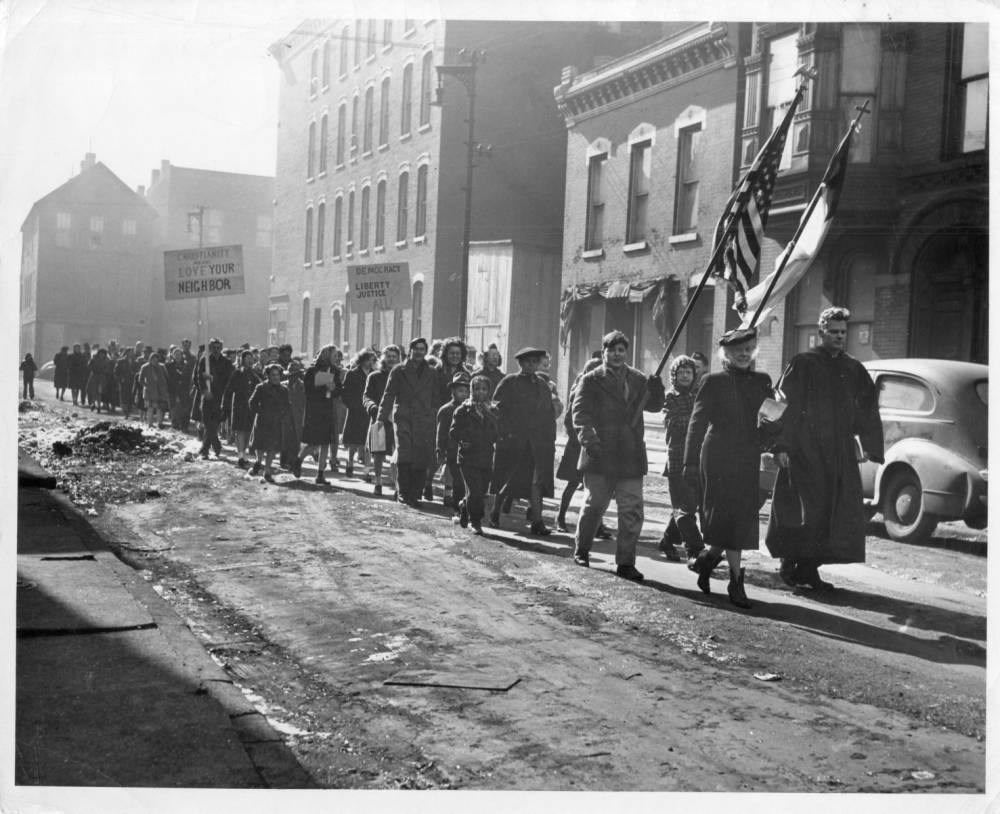
In the shadow of World War II, the Covenant Church took an official stance against racial discrimination. The Annual Meeting of 1944 adopted a resolution that reads in part: “We believe that all men are of one blood, and that all discrimination, based upon race, creed or nationality, is not in keeping with the Christian profession and life, and further, that it fosters conflict and war.” 1Covenant Yearbook 1944, 133. The 1946 Annual Meeting minutes explicitly linked the racial ideology of Nazism and racial discrimination in the United States: “The Nazis built their house of fury on a foundation of racial superiority, with its implicate of racial hatred. The Nazis are out of power but Nazism is far from dead.” 2Covenant Yearbook 1946, 165. Between 1946 and 1968, with only six exceptions, every Annual Meeting issued a resolution affirming the equal dignity of all people and rejecting racial discrimination. 3Covenant Yearbook 1947, 1955, 1956, 1960, 1961, and 1967; David Nystrom, “The Covenant Commission on Christian Action,” Covenant Quarterly 44, no. 3 (1987): 25.
Christian Citizenship Commission
Annual Meeting resolutions did not emerge ex nihilo, but were brought by a commission that sought to resource local congregations and guide them in action. In 1944 the Covenant Church established the Committee on Civic Relations to mold a Christian mindset toward various matters of civility. The name was changed in 1948 to Christian Citizenship Commission (and in 1968 to the Commission on Christian Action). 4David Nystrom, “The Covenant Commission on Christian Action,” Covenant Quarterly 44, no. 3 (1987): 5–35. See especially pp. 25–29 for Nystrom’s discussion on race relations. The Christian Citizenship Commission would study and offer its opinion on suffrage, civil rights, international wars, political affairs, social ethics, and other important civic issues. The denominational commission encouraged the formation of congregational commissions and provided them with resources and recommendations. This commission also sought to connect with the civil work of other churches and denominations, representing the Covenant Church in ecumenical conferences and reporting back to the Covenant in publications. 5Covenant Yearbook 1948, 178.
The practical action of the commission primarily took place through congregational commissions established at their request and under their direction. At its inception, the commission recommended the establishment of a “committee on civic relations” in every Covenant church, sending letters to each congregation with this request in November 1947. As the 1948 report stated, “Commission members quickly realized that no program of information or action could be implemented unless there were local committees,” reporting that sixty churches had formed such a committee. 6Covenant Yearbook 1948, 92.
Education
A significant component of the commission’s work was creating and compiling resources for Covenant congregations. This included writing a general manual on Christian citizenship as well as identifying existing resources on specific issues. The 1961 Annual Meeting approved the commission’s proposal that race be adopted as the “issue of the year,” launching a year of “denomination-wide study of Christianity and racial relations.” 7Covenant Yearbook 1962, 228. In support of this, the commission compiled extensive resources and mailed these to each congregation:
To challenge Covenanters to better align their practices with their beliefs, the commission prepared and sent to all Covenant churches a discussion guide which defined the problem, presented perspectives from the Bible, the churches, and government, and suggested local areas in which these guidelines appeared relevant. Also included in the mailing were several studies by other Protestant denominations and a comprehensive bibliography on the issue. 8Covenant Yearbook 1962, 163.
Prior to the Sunday dedicated to Christian citizenship in October 1966, the commission published an insert in the Covenant Companion with suggestions for the practical implementation of each of the 1966 resolutions. One of the 1966 resolutions “vigorously reaffirmed” resolutions on race relations from 1962, 1963, and 1965, again charging Covenanters with pursuing racial justice. 9Covenant Yearbook 1966, 196; full report pp. 194–98.
Action
In David Nystrom’s assessment, Covenant resolutions on “race relations” show development toward action, solidarity with oppressed groups, and understanding of complex social problems. 10David Nystrom, “The Covenant Commission on Christian Action,” Covenant Quarterly 44, no. 3 (1987): 25. During these years we find increasingly specific calls to action, focused on actively pursuing integration in all arenas, with an emphasis on housing discrimination. The 1962 Annual Meeting not only “reaffirm[ed] its previous forthright stands against racial prejudice in every form,” but also resolved practical implementations including advocacy for voting rights, equal education, and integration of public facilities. 11Covenant Yearbook 1962, 247.
The 1963 resolution, “Race Relations in Neighborhood and Church,” identified housing discrimination as the root of other inequalities: “The continued condition of segregated housing produces segregation of schools, churches, and community enterprises.” 12Covenant Yearbook 1962, 247. Subsequent resolutions advocated for fair housing legislation and called Covenanters to join other churchmen to accomplish such legislation where it had not been enacted. 13Covenant Yearbook 1963, 229. The 1965 resolution, “Concern for Racial Justice,” called Covenant churches and individuals to “repent of the sin of racial discrimination” and to “assum[e] the initiative in integrating both our urban and rural congregations and their staffs, the faculties and student bodies of our schools, and the employees and residents of our institutions.” 14Covenant Yearbook 1965, 222–23, emphasis added.
Where Is It Written? Covenant Publications
The Evangelical Covenant Church is known for its commitment to publications. The commission used publications to communicate its purpose, advocacy for congregational action, and resources for engaging specific issues, including racial injustices. 15“A Christian Citizenship Commission Is Formed,” Covenant Weekly, February 20, 1948, 5.
In the summer of 1965, Carl G. Lugn, pastor of Evanston Evangelical Covenant Church, wrote “Race Relations: A Community Profile and Proposal” for the Covenant Quarterly. Lugn was active on neighborhood committees concerned with integration and unfair hiring and housing practices. A 1964 study in Evanston described the situation as one “not of integration or segregation but of accommodation.” 16Carl G. Lugn, “Race Relations: A Community Profile and Proposal,” Covenant Quarterly 23, no. 3 (August 1965): 3–8.
Lugn argued that stable, integrated communities are created through social contacts and residential socialization, and he urged an end to white flight and blockbusting, common practices of the day that undermined interracial communities. 17Carl G. Lugn, “Race Relations: A Community Profile and Proposal,” Covenant Quarterly 23, no. 3 (August 1965): 7.
Covenant Youth Today devoted an entire issue to the civil rights movement. The January 1964 issue, “Negros on the March,” featured Andrew Young and published excerpts from Martin Luther King Jr.’s “Letter from Birmingham Jail.” It also included photographs of the Sixteenth Street Baptist Church after the 1963 bombing. The magazine highlighted young people’s nonviolent demonstrations in Alabama and related them to Christian heritage and moral responsibility. 18Andrew J. Young, “Everybody Wants Freedom,” Covenant Youth Today 10, no. 1 (January 1964): 2–5, 9.
Other youth and denominational publications carried testimony, reflections, and studies that challenged claims of racial inferiority and encouraged active engagement against discrimination. 19Everett L. Wilson, “Neither Easy Nor Naive,” Covenant Youth Today 11, no. 1 (January 1965): 2–3; Claude E. Stipe, “Race and Culture: A Valid Basis for Segregation?,” Covenant Youth Today 11, no. 1 (January 1965): 4–12; Phyllis Reynolds Naylor, “Four Vignettes from an American Family Tree,” Covenant Youth Today 11, no. 3 (July 4, 1965): 2–7.
Publications also publicized Covenant participation in civil rights actions. In April 1965 the Covenant Companion reported Covenant representation in the 1965 Selma-to-Montgomery march, listing participants from multiple Covenant churches who joined the historic demonstration led by Martin Luther King Jr. 20Carl Philip Anderson, ed., “Covenanters Share in Alabama March,” Covenant Companion 54, no. 8 (April 9, 1965): 18–19.
Local Congregational Case Studies
The commission recognized that resolutions would be effective only if interpreted and carried out by local committees. Two congregations that played prominent roles in the denomination’s civil-rights-era engagement were Community Covenant Church (Minneapolis, MN) and North Park Covenant Church (Chicago, IL). 21Covenant Yearbook 1962, 163.
Community Covenant Church, Minneapolis
In October 1966, racially motivated rioting followed a summer of tension in Minneapolis. Community Covenant Church planted a “brotherhood tree” — a multiracial act welcoming the city’s mayor and local NAACP leadership — planted by a 12-year-old African American boy. 22Carl Philip Anderson, ed., “Symbolic Tree Is Planted,” Covenant Companion 55, no. 19 (September 23, 1966): 22. Pastor Arnold Bolin urged the community to “nurture and tend to the growth of brotherhood and goodwill.” 23Carl Philip Anderson, “Symbolic Tree Is Planted,” Covenant Companion 55, no. 19 (September 23, 1966): 22.
CCC described itself as a “multi-racial church…not a ‘black church,’ not a ‘white church,’ but a group where skin is no consideration.” The church hosted programs sending inner-city children to rural congregations to foster mutual understanding and hosted forums and practical experiences to raise awareness of the effects of racial prejudice. 24Community Covenant Church, “What Do You Know about Community Covenant Church,” Chicago, IL: Covenant Archives and Historical Library, Record Series 8/11/14/56, n.d.; Carl Philip Anderson, ed., “City Youth Visit Country: Cooperative Venture Is Met with Enthusiasm,” Covenant Companion 55, no. 15 (July 29, 1966): 14–15.
North Park Covenant Church, Chicago
Douglas Cedarleaf (pastor 1955–1970) preached prophetically on racial justice. In a June 16, 1963 sermon, he asked his listeners to choose whether they truly wanted God’s kingdom and criticized silence in the face of violent oppression, invoking images of fire hoses and dogs used against demonstrators. 25Douglas Cedarleaf, “Thy Kingdom Come, Thy Will Be Done,” sermon, North Park Covenant Church, Chicago, June 16, 1963, Covenant Archives and Historical Library; printed in this issue, pp. 33–44.
Cedarleaf proposed visible signs of solidarity (badges of black and white cloth joined) and led sponsorship efforts such as supporting a Haitian family. He warned congregants of backlash but urged them to act in accordance with God’s will. 26Douglas Cedarleaf, “Thy Kingdom Come, Thy Will Be Done,” sermon, 1963.
NPCC engaged in cross-cultural worship exchanges, mutual hospitality with integrated churches, and financial restitution for victims of racist violence. They provided education through Sunday-school series such as “Towards Racial Redemption,” curated library resources on integration and race, and hosted televised-series viewing parties to facilitate discussion. NPCC also started a coffeehouse, the Broken Wall, as a community dialogue space where race relations and social topics were openly discussed. 27North Park Covenant Church Newsletters 1966–1968; Carl Philip Anderson, ed., “Coffee and…,” Covenant Companion (October 8, 1965): 14–15, 26.
From 1963–1968, NPCC’s Christian citizenship committee worked on fair housing and equal educational opportunities, partnering with the North River Commission (a local community development partnership). NPCC supported school integration measures such as busing and promoted a “good neighbor pledge” to encourage members to accept neighbors of color; over 250 members (33%) responded positively in February 1968, which led to a community organization advocating equal housing. 28North Park Covenant Church, “Annual Reports 1968,” p. 11; North River Commission records; North Park Covenant Church Newsletter, April 1967.
Following Martin Luther King Jr.’s assassination, NPCC’s committee sponsored discussions on the causes and aftermath of riots and contributed a special offering to the Southern Christian Leadership Conference. 29North Park Covenant Church, “Annual Reports 1968,” p. 22.
In September 1968 NPCC used the pulpit to highlight race and poverty and reprinted denominational resolutions calling for confession of racism, increased contact with areas of tension, and active involvement in power structures to address the urban crisis. 30“Excerpts from the Report of the Resolutions Committee,” North Park Covenant Church Newsletter, June 1968; Covenant Archives and Historical Library, Record Series 8/2/10/23, Box 6, Folder 7.
Conclusion
The Evangelical Covenant Church was active in pursuing racial reconciliation during 1963–1968. The denomination’s published resolutions and the work of the Christian Citizenship Commission helped educate and mobilize congregations. Local churches like Community Covenant Church and North Park Covenant Church demonstrated how denominational commitments were enacted through prophetic preaching, cross-cultural encounter, community outreach, education, and financial support. These actions contributed to the ECC’s ongoing efforts in racial righteousness and reconciliation.
This article originally published with the Covenant Quarterly on August 2, 2016.
Endnotes
- 1Covenant Yearbook 1944, 133. ↩︎
- 2Covenant Yearbook 1946, 165. ↩︎
- 3Covenant Yearbook 1947, 1955, 1956, 1960, 1961, and 1967; David Nystrom, “The Covenant Commission on Christian Action,” Covenant Quarterly 44, no. 3 (1987): 25. ↩︎
- 4David Nystrom, “The Covenant Commission on Christian Action,” Covenant Quarterly 44, no. 3 (1987): 5–35. See especially pp. 25–29 for Nystrom’s discussion on race relations. ↩︎
- 5Covenant Yearbook 1948, 178. ↩︎
- 6Covenant Yearbook 1948, 92. ↩︎
- 7Covenant Yearbook 1962, 228. ↩︎
- 8Covenant Yearbook 1962, 163. ↩︎
- 9Covenant Yearbook 1966, 196; full report pp. 194–98. ↩︎
- 10David Nystrom, “The Covenant Commission on Christian Action,” Covenant Quarterly 44, no. 3 (1987): 25. ↩︎
- 11Covenant Yearbook 1962, 247. ↩︎
- 12Covenant Yearbook 1962, 247. ↩︎
- 13Covenant Yearbook 1963, 229. ↩︎
- 14Covenant Yearbook 1965, 222–23, emphasis added. ↩︎
- 15“A Christian Citizenship Commission Is Formed,” Covenant Weekly, February 20, 1948, 5. ↩︎
- 16Carl G. Lugn, “Race Relations: A Community Profile and Proposal,” Covenant Quarterly 23, no. 3 (August 1965): 3–8. ↩︎
- 17Carl G. Lugn, “Race Relations: A Community Profile and Proposal,” Covenant Quarterly 23, no. 3 (August 1965): 7. ↩︎
- 18Andrew J. Young, “Everybody Wants Freedom,” Covenant Youth Today 10, no. 1 (January 1964): 2–5, 9. ↩︎
- 19Everett L. Wilson, “Neither Easy Nor Naive,” Covenant Youth Today 11, no. 1 (January 1965): 2–3; Claude E. Stipe, “Race and Culture: A Valid Basis for Segregation?,” Covenant Youth Today 11, no. 1 (January 1965): 4–12; Phyllis Reynolds Naylor, “Four Vignettes from an American Family Tree,” Covenant Youth Today 11, no. 3 (July 4, 1965): 2–7. ↩︎
- 20Carl Philip Anderson, ed., “Covenanters Share in Alabama March,” Covenant Companion 54, no. 8 (April 9, 1965): 18–19. ↩︎
- 21Covenant Yearbook 1962, 163. ↩︎
- 22Carl Philip Anderson, ed., “Symbolic Tree Is Planted,” Covenant Companion 55, no. 19 (September 23, 1966): 22. ↩︎
- 23Carl Philip Anderson, “Symbolic Tree Is Planted,” Covenant Companion 55, no. 19 (September 23, 1966): 22. ↩︎
- 24Community Covenant Church, “What Do You Know about Community Covenant Church,” Chicago, IL: Covenant Archives and Historical Library, Record Series 8/11/14/56, n.d.; Carl Philip Anderson, ed., “City Youth Visit Country: Cooperative Venture Is Met with Enthusiasm,” Covenant Companion 55, no. 15 (July 29, 1966): 14–15. ↩︎
- 25Douglas Cedarleaf, “Thy Kingdom Come, Thy Will Be Done,” sermon, North Park Covenant Church, Chicago, June 16, 1963, Covenant Archives and Historical Library; printed in this issue, pp. 33–44. ↩︎
- 26Douglas Cedarleaf, “Thy Kingdom Come, Thy Will Be Done,” sermon, 1963. ↩︎
- 27North Park Covenant Church Newsletters 1966–1968; Carl Philip Anderson, ed., “Coffee and…,” Covenant Companion (October 8, 1965): 14–15, 26. ↩︎
- 28North Park Covenant Church, “Annual Reports 1968,” p. 11; North River Commission records; North Park Covenant Church Newsletter, April 1967. ↩︎
- 29North Park Covenant Church, “Annual Reports 1968,” p. 22. ↩︎
- 30“Excerpts from the Report of the Resolutions Committee,” North Park Covenant Church Newsletter, June 1968; Covenant Archives and Historical Library, Record Series 8/2/10/23, Box 6, Folder 7. ↩︎
SHARE WITH FRIENDS